

Parental Sleep Anxiety: Why New Parents Struggle to Sleep and How to Cope
June 23, 2026
When Do Babies Develop a Circadian Rhythm? Understanding Your Baby’s Internal Clock
July 12, 2026
Summary
Smart sleep monitoring combines breathing movement, crying, mattress-level temperature, mattress-level humidity and baby sleep tracking to provide meaningful sleep insights. While smart alerts help parents rest with confidence during the night, long-term sleep monitoring helps them better understand their baby’s sleep patterns and make informed decisions over time.
One of the first pieces of advice new parents receive is both simple and frustrating: sleep when your baby sleeps.
It’s sensible advice. When you have a newborn, your days revolve around feeding, burping, changing diapers, bathing, soothing, admiring your baby, doing endless loads of tiny laundry, and wondering why no one included an instruction manual. “Sleeping through the night” often means managing three consecutive hours of sleep—on a good night. Sleep deprivation is common during the first year, affecting mood, concentration, decision-making and even physical health.
The truth though is that even when the baby is asleep, the parents often aren’t. Instead of resting, they find themselves listening for every sound through the baby monitor, wondering whether their baby has settled after a brief cry, or quietly opening the nursery door one more time “just to make sure everything is okay.”
This constant state of alertness is something many parents experience, and for some, it can develop into parental sleep anxiety—the feeling that it’s impossible to truly relax because something might happen while your baby is sleeping.
From monitoring your baby to understanding their sleep
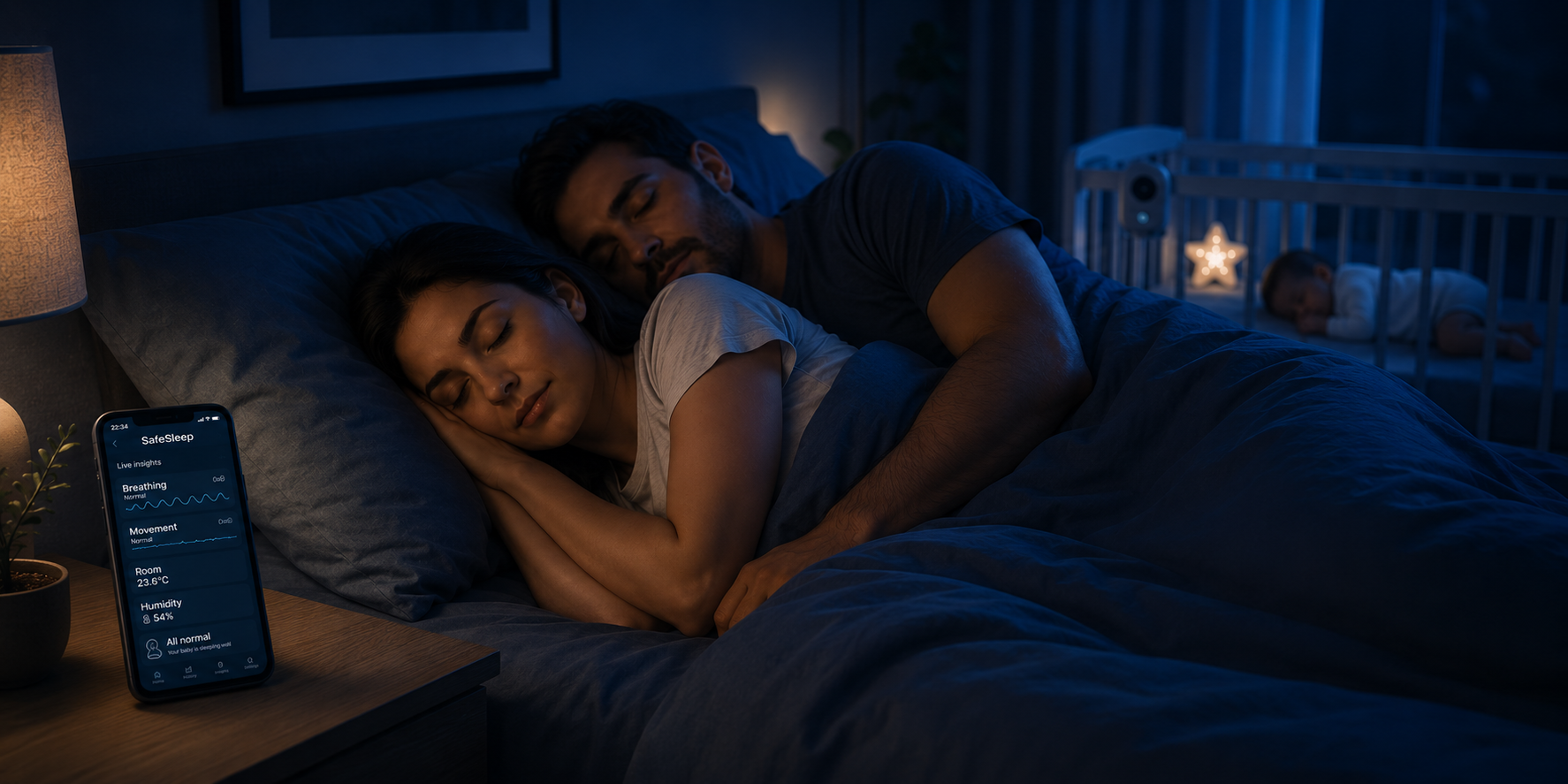
This is where smart sleep monitoring can make a real difference by providing information that would otherwise require constant checking. Instead of feeling the need to watch a screen continuously or check on your baby every few minutes, parents can rely on smart alerts to notify them when their attention is genuinely needed. That allows parents to step back, relax and get some much-needed rest themselves.
Unlike a traditional baby monitor, multi-sensor sleep monitoring combines information from several sources. It can observe breathing movement, crying, mattress-level temperature and humidity, and longer-term sleep trends. By bringing these data points together, smart monitoring helps parents build a more complete picture of their baby’s sleep and immediate sleep environment.
Each measurement tells part of the story. Together, they provide meaningful sleep insights that help parents understand not only whether their baby is sleeping, but how they are sleeping, whether their sleep environment remains comfortable, and how sleep changes over time. That understanding doesn’t replace parental instinct, but it helps parents make decisions with greater confidence.
Breathing: reassurance without disturbing your baby
Anyone who has cared for a newborn has probably leaned over the crib at least once—often many more times—to check that tiny chest rising and falling. It is a completely natural instinct. Babies breathe differently from adults, with pauses, irregular rhythms and surprisingly quiet breaths, all of which can make parents wonder whether everything is normal.
Sleep monitoring systems that observe breathing movement allow parents to check on their baby without entering the room or waking them. Rather than relying on repeated visual checks, parents can feel reassured that breathing movement continues while their baby sleeps peacefully.
It is important, however, to understand what breathing monitoring is designed to do. It is not intended to diagnose medical conditions or replace professional healthcare. Instead, it provides continuous observation and alerts parents if breathing movement is no longer detected for a predetermined period of time.
This distinction matters because many parents expect monitoring to provide certainty about every aspect of their baby’s health. No technology can do that. What it can do is reduce unnecessary uncertainty during those long hours when parents are trying to rest while their baby sleeps in another room.
For many families, that reassurance alone can make an enormous difference.
What breathing monitoring can tell you
- Whether your baby continues breathing normally throughout the night.
- How breathing patterns change during different stages of sleep.
- When temporary illnesses, such as a cold or nasal congestion, appear to affect breathing.
- When breathing movement is no longer detected for the system’s predefined safety threshold, triggering a smart alert.
- How breathing patterns evolve as your baby grows.
Crying: understanding when your baby really needs you
One of the biggest surprises for first-time parents is discovering just how noisy babies can be while asleep.
During the first months of life, babies spend almost half of their sleep in active sleep (REM). During this stage they may grunt, sigh, twitch, briefly cry or whimper, and even open their eyes without actually waking. To an exhausted parent listening through a wall or a traditional baby monitor, every sound can feel like a reason to rush into the nursery.
This is where smart sleep monitoring offers valuable context. Rather than reacting to every small vocalisation, parents can observe whether a sound develops into sustained crying or simply fades away as the baby settles back to sleep. Multi-sensor sleep monitoring combines crying with other sleep data, helping parents distinguish between a brief transition during sleep and a genuine waking that requires comfort.
That distinction benefits both parents and babies. Imagine a six-month-old who briefly fusses between sleep cycles. Entering the room immediately, switching on a light or picking the baby up may unintentionally interrupt their opportunity to settle independently. On the other hand, sustained crying caused by hunger, discomfort or illness deserves a prompt response. Smart baby sleep monitoring doesn’t encourage parents to ignore their baby but it helps them respond with better information and greater confidence.
What crying monitoring can tell you
- Whether your baby has briefly stirred or fully woken.
- How often your baby wakes during the night.
- When crying develops into sustained distress rather than brief sleep vocalisations.
- When changes in crying patterns coincide with teething, illness or developmental milestones.
- Whether bedtime routines are helping reduce night wakings over time.
Temperature: creating a comfortable sleep environment
Parents naturally pay attention to the nursery temperature, but the room temperature is not always the same as the temperature your baby experiences while sleeping.
Your baby sleeps on a mattress, often inside a sleep sack, surrounded by bedding and protected by the sides of the crib. This creates a small microclimate around the baby that can be warmer or cooler than the air measured elsewhere in the room. A wall thermometer or thermostat may tell you the temperature of the nursery, but it cannot always tell you the conditions at mattress level, where your baby is actually sleeping.
This is why multi-sensor sleep monitoring measures temperature where it matters most. By continuously monitoring the baby’s immediate sleep environment, smart monitoring helps parents understand how conditions change throughout the night rather than relying on occasional checks.
Temperature matters because babies are still developing their ability to regulate body temperature. Sleep experts generally recommend keeping the sleep environment comfortably cool rather than overly warm, with a nursery temperature of around 16–20°C (61–68°F). Mattress-level temperature monitoring adds another layer of information by showing the conditions your baby is actually experiencing, helping parents decide whether clothing, sleep sacks or room heating need adjusting.
Instead of relying on guesswork after several restless nights, parents can make informed decisions based on real sleep data and gradually learn what helps their baby sleep most comfortably.
What temperature monitoring can tell you
- Whether your baby’s mattress-level sleep environment remains within a comfortable temperature range throughout the night.
- How temperature changes between bedtime and the early morning hours.
- Whether your baby’s sleep environment is becoming warmer or cooler than expected, even if the room temperature appears unchanged.
- When seasonal weather or home heating and cooling systems begin to affect your baby’s sleep environment.
- Whether changes to clothing, sleep sacks or room temperature improve your baby’s comfort over time.
Humidity: more than the air in the nursery
Humidity is often overlooked, yet it plays an important role in your baby’s sleep environment. Most discussions focus on the humidity of the room, which can become very dry during winter heating or air conditioning. Dry air may contribute to nasal dryness or congestion, while excessive humidity can make the sleeping environment less comfortable.
Multi-sensor sleep monitoring goes one step further by measuring humidity at mattress level, where your baby is actually sleeping. This provides a more accurate picture of the conditions inside the crib rather than elsewhere in the nursery.
Mattress-level humidity can also reveal changes that room sensors cannot detect. A damp mattress protector, increased perspiration during a warm night, or even a leaking diaper can all alter the immediate sleep environment. Identifying these changes early helps parents understand why a baby who settled comfortably at bedtime may suddenly become restless during the night.
Like temperature, humidity is only one part of the sleep environment, but together these measurements provide valuable sleep insights that help parents create a more comfortable place for their baby to rest.
What humidity monitoring can tell you
- Whether humidity levels in your baby’s immediate sleep environment remain within a comfortable range.
- How seasonal heating or air conditioning affects humidity around the mattress.
- When increased humidity may indicate perspiration, damp bedding or a leaking diaper.
- Whether changes in humidity coincide with congestion, discomfort or restless sleep.
- How adjustments to the nursery environment improve your baby’s comfort over time.
Sleep trends: understanding your baby’s sleep over time
Knowing that they will be alerted if their baby needs them means parents don’t have to spend the night constantly checking the monitor. For many families, that reassurance is what makes it possible to rest. But while smart alerts provide peace of mind in the moment, smart baby sleep monitoring delivers something equally valuable over time: understanding.
This is where baby sleep tracking and multi-sensor sleep monitoring make the biggest difference. Individual nights can be unpredictable, and sleep deprivation has a way of making isolated events feel permanent. Parents often remember difficult nights much more vividly than good ones. By collecting sleep data over days and weeks, the system turns individual nights into meaningful sleep insights, revealing patterns that would otherwise be difficult to recognize.
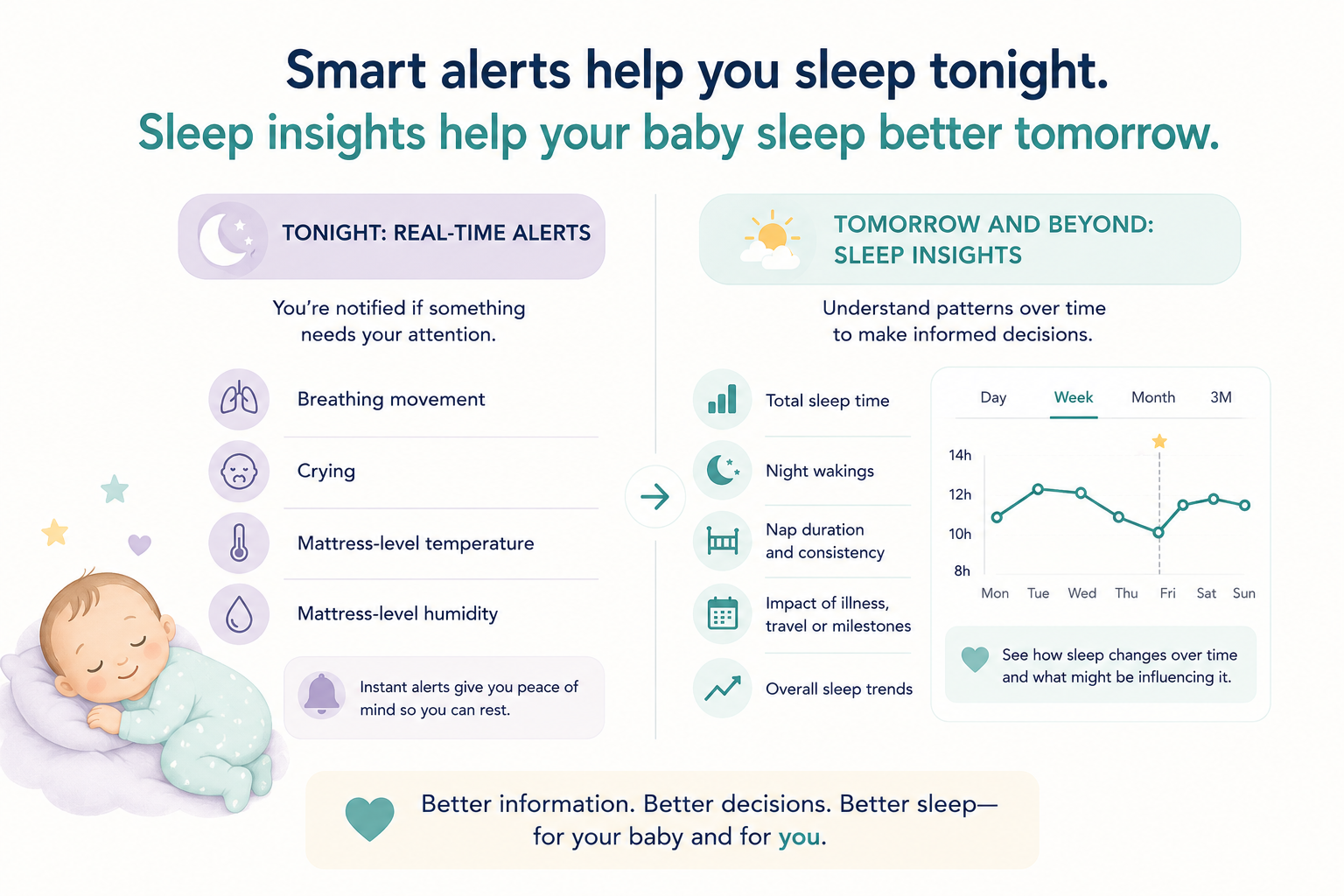
“Smart alerts help you sleep tonight. Sleep insights help your baby sleep better tomorrow.
Those long-term trends help answer questions that memory alone cannot. Is your baby gradually sleeping for longer stretches? Are naps becoming shorter as they grow? Did sleep change after a cold, a growth spurt, travel or a new bedtime routine? Looking at these patterns helps parents understand that many changes are temporary and part of healthy development, rather than a sign that something is wrong.
Baby sleep trend data can also support conversations with healthcare professionals. Instead of relying on memory, parents can describe sleep patterns more accurately, making it easier to discuss concerns and monitor progress over time.
What baby sleep trends can tell you
- How your baby’s total sleep time changes over days, weeks and months.
- Whether night wakings are becoming more or less frequent.
- How nap duration and consistency evolve as your baby grows.
- When developmental milestones, illness, travel or changes in routine begin to affect sleep.
- Whether bedtime routines are leading to longer stretches of uninterrupted sleep.
- Whether your baby’s overall sleep is gradually improving, even if individual nights remain challenging.
Why multi-sensor sleep monitoring matters
No single measurement can explain how your baby is sleeping. Breathing movement, crying, mattress-level temperature, mattress-level humidity and baby sleep tracking each provide one piece of the puzzle. It is when these measurements are combined that multi-sensor sleep monitoring delivers its greatest value, transforming individual observations into meaningful sleep insights.
Imagine that your baby suddenly starts waking more often during the night. Cry monitoring tells you that sleep has become more disrupted, but not why. Temperature monitoring may show that the sleep environment at mattress level has become warmer than usual during the early morning hours. Humidity monitoring may reveal increased moisture caused by perspiration or a leaking diaper. Sleep trend data may show that the changes began several days ago rather than overnight. Looking at all these signals together gives parents a much clearer understanding of what may be affecting their baby’s sleep.
This is what makes smart sleep monitoring different from simply watching a baby monitor. Instead of relying on guesswork, parents can begin asking more informed questions. Is my baby too warm? Is a cold affecting their breathing? Has a change in bedtime routine improved sleep over the past week? The goal is not to replace parental instinct, but to support it with objective information.
No monitoring system can explain every restless night, and no technology replaces responsive parenting. But by combining breathing movement, crying, mattress-level environmental conditions and long-term sleep trends, multi-sensor sleep monitoring helps parents better understand their baby’s sleep. And better understanding is often the first step towards better sleep—for both babies and parents.
Information supports confidence
Parents make hundreds of decisions every day, many of them while exhausted. Is the baby uncomfortable? Are they waking more than usual? Is the mattress too warm? Has the bedtime routine made a difference? When every answer depends on guesswork, parental sleep anxiety naturally grows.
The purpose of smart sleep monitoring is not to eliminate uncertainty—no technology can do that. Babies continue to grow, change and surprise us every day. Its purpose is to replace some of that uncertainty with reliable information, meaningful sleep insights and smart alerts that help parents respond with confidence rather than react out of worry.
In the end, that’s what multi-sensor sleep monitoring offers. Not perfect sleep, and certainly not perfect parenting, but a clearer understanding of how your baby sleeps and how their sleep environment changes over time.
Better understanding leads to better decisions, and better decisions can contribute to better sleep—for babies and for the people who care for them.
Because when you know that baby sleeps well, you can rest better.