
How Sleep Deprivation Affects Parents of Babies
June 13, 2026
Why Does My Newborn Breathe So Irregularly?
June 19, 2026
Summary
Infant breathing is naturally faster and more variable than adult breathing. Newborns may have noisy breathing, brief pauses, and changing breathing patterns during sleep as their respiratory system develops. Most of these patterns are normal, but signs of respiratory distress should always be evaluated by a healthcare professional.
Many parents worry about their baby’s breathing, especially during the first weeks after birth. Newborn breathing often looks very different from adult breathing. It may be fast, irregular, noisy, or include brief pauses that can seem alarming.
In most healthy babies, these patterns are a normal part of development. Understanding how infant breathing changes during sleep and wakefulness can help parents distinguish between expected breathing patterns and signs that require medical attention.
Why Do Parents Worry So Much About Their Baby’s Breathing?
Many parents find themselves checking whether their baby is breathing before going to sleep. Others wake repeatedly during the night to watch their baby’s chest rise and fall.
Parents receive constant messages about safe sleep and SIDS prevention. While these recommendations are important, they can sometimes make every unusual sound, movement, or breathing change feel like a potential warning sign.
The reality is that healthy babies often breathe in ways that look unusual to adults. Their bodies automatically regulate breathing, oxygen levels, and sleep patterns throughout the day and night without any intervention from parents.
The Development of Breathing Before and After Birth
To understand why newborn breathing appears so different, it helps to know how the respiratory system develops.
Before birth, babies do not breathe air. During pregnancy, oxygen is delivered through the placenta and umbilical cord. The lungs are filled with fluid and are not responsible for oxygen exchange.
Everything changes at birth.
Within moments of delivery, a newborn must begin breathing independently. The lungs expand, fluid is cleared, and the entire respiratory system takes on its lifelong role. This transition is one of the most remarkable adaptations in human development.
However, the respiratory system does not become fully mature overnight.
After birth:
- Lung tissue continues developing
- Airways grow larger
- Breathing muscles become stronger
- Neural control of breathing improves
- Sleep-related breathing patterns become more stable
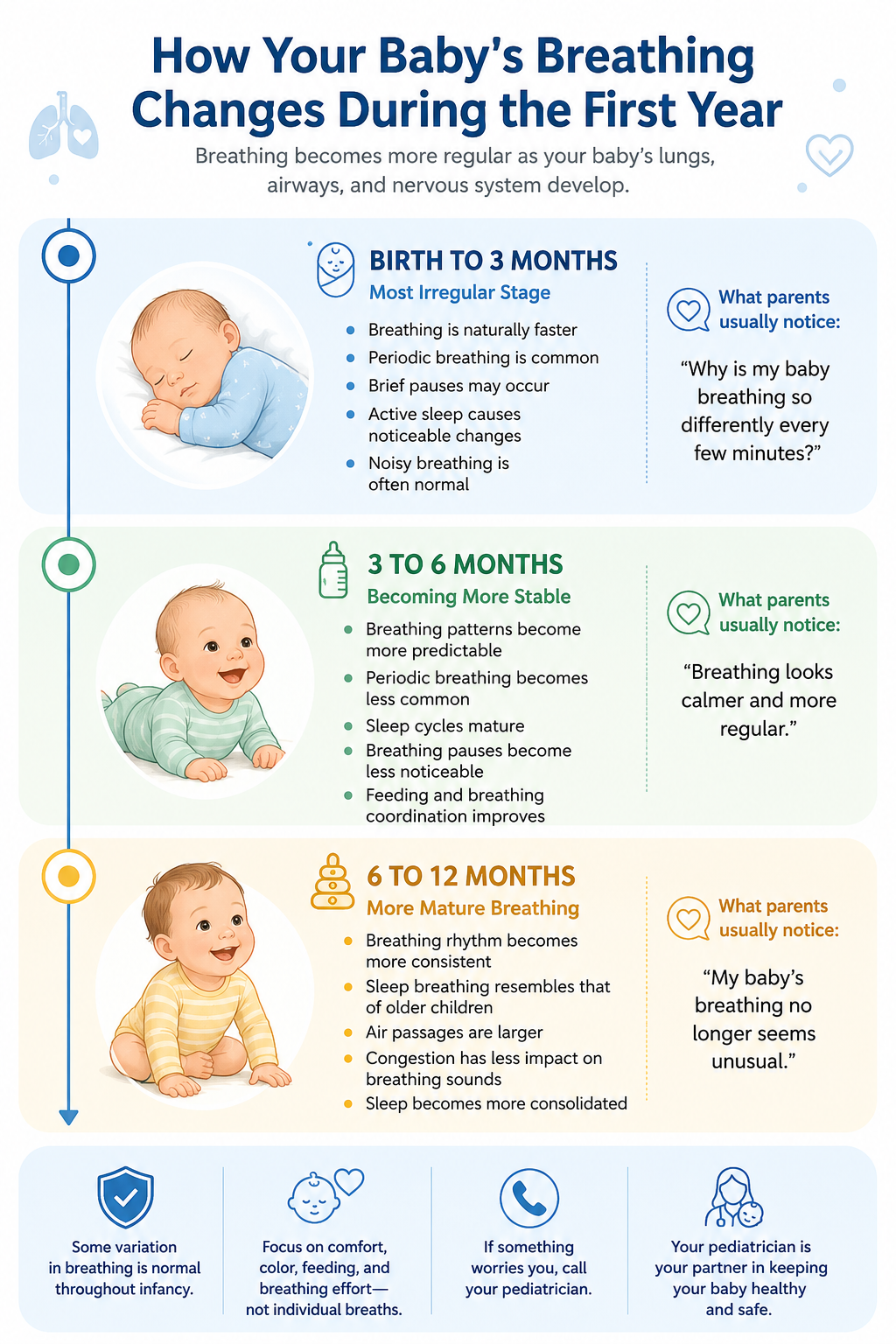
This ongoing development explains why newborn breathing differs from the breathing of older infants and children.
By the end of the first year, breathing patterns have generally become much more predictable and adult-like.
Nose Breathing and Mouth Breathing in Babies
During the first months of life, babies are often described as preferential nasal breathers.
This means they naturally rely on their noses for most of their breathing, especially during feeding and sleep. Breathing through the nose allows babies to coordinate sucking, swallowing, and breathing more efficiently.
Because babies depend so heavily on their noses, even mild congestion can make breathing sound noisy and can sometimes interfere with feeding or sleep.
Parents often become concerned when they notice their baby sleeping with their mouth open. Occasional mouth breathing is not necessarily a cause for concern. A baby with a cold or temporary nasal congestion may breathe through their mouth more often until the congestion improves.
However, persistent mouth breathing deserves discussion with a healthcare professional, particularly if it is associated with:
- Chronic congestion
- Snoring
- Feeding difficulties
- Poor sleep quality
- Difficulty breathing through the nose
In most healthy infants, nasal breathing remains the primary breathing pattern throughout the first year of life.
What Is a Normal Breathing Rate for a Baby?
One of the most common questions parents ask is how fast their baby should be breathing.
The answer depends on age. Babies naturally breathe faster than adults because their bodies use more oxygen to support rapid growth and development.
When a baby is calm, resting, or sleeping, the following breathing rates are generally considered normal:
| Age | Typical Breaths Per Minute |
| Newborn (0–1 month) | 30–60 |
| 1–6 months | 30–50 |
| 6–12 months | 25–40 |
These numbers are guidelines rather than strict rules. Breathing rates can temporarily increase during:
- Active sleep
- Crying
- Feeding
- Excitement
- Physical activity
- Fever
For this reason, breathing should ideally be counted when your baby is calm or sleeping peacefully.
How to Count Your Baby’s Respiratory Rate
If you are concerned about your baby’s breathing, watch the rise and fall of the chest or abdomen.
One rise and one fall count as a single breath.
Count for a full minute rather than for a shorter period. Infant breathing is often irregular, and counting for a complete minute provides a more accurate picture.
What Does Normal Newborn Breathing Look Like During Sleep?
Baby sleep and breathing are closely connected.
When adults sleep, breathing becomes slightly slower and more regular. In infants, the relationship is more complex.
During sleep, the brain continuously adjusts breathing in response to oxygen and carbon dioxide levels. Because an infant’s nervous system is still developing, these adjustments can be more noticeable.
Different sleep stages also influence breathing.
During quiet sleep, breathing is usually:
- Slower
- More regular
- Less variable
During active sleep, breathing may become:
- Faster
- Irregular
- More variable in depth and rhythm
These fluctuations are a normal consequence of healthy sleep development.
Parents who observe their baby sleeping for extended periods often notice several different breathing patterns during a single nap. This variation is usually a sign that the baby is cycling through normal sleep stages.
Common Newborn Breathing Patterns
Newborn breathing rarely follows a perfectly steady rhythm. During the first months of life, the systems that control breathing are still maturing, which means healthy babies often show breathing patterns that can appear unusual to adults.
Some common newborn breathing patterns include:
Variable Breathing Rate. A baby may breathe faster for several breaths and then slow down again. Newborn fast breathing in sleep or during wakefulness is common and should be of no concern in an otherwise healthy baby.
Changes in Breath Depth. Not every breath is the same size. Healthy babies occasionally take deeper breaths followed by several shallower breaths.
Occasional Sighs. Newborns sometimes take a noticeable deep breath or sigh. Sighs help keep the lungs expanded and are a normal part of breathing.
Brief Pauses. Healthy babies may occasionally pause for a few seconds before resuming their normal breathing rhythm. These short pauses are usually harmless and are different from apnea.
Noisy Breathing. Snuffles, squeaks, snorts, and occasional congestion-like sounds are common in newborns. Because their airways are small and narrow, even normal airflow can produce noticeable sounds.
Most of these breathing patterns become less obvious as a baby’s breathing control matures during the first year of life.
Noisy Breathing: Why Babies Make So Many Sounds During Sleep
Many parents expect a sleeping baby to be silent. Instead, they discover that newborns can be surprisingly active and noisy sleepers.
Healthy babies may make a variety of sounds while breathing, particularly during the first months of life. These sounds are often more noticeable at night, when parents are quietly observing their baby.
Common sounds include:
- Snuffling
- Snorting
- Squeaking
- Grunting
- Whistling
- Occasional sighing
In many cases, these noises occur because babies have very small airways and nasal passages. Even tiny amounts of mucus or normal airway secretions can create sounds that seem surprisingly loud.
Some sounds are associated with normal sleep stages. During active sleep, babies may move, vocalize softly, and change their breathing patterns. These changes can create brief noises that disappear on their own.
Sighing is also normal. Babies occasionally take deeper breaths that help expand the lungs and maintain healthy airflow.
How Can I Distinguish Between Noisy Breathing And Difficult Breathing?
A baby who sounds noisy but appears comfortable, maintains normal skin color, feeds well, and breathes without effort is often perfectly healthy.
By contrast, a baby who is working hard to breathe, even if relatively quiet, requires prompt medical attention.
Contact your pediatrician if noisy breathing is persistent, worsening, associated with feeding difficulties, or accompanied by signs of respiratory distress.
Safe Sleep Position and Breathing
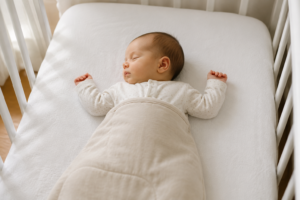 One of the most common concerns among new parents is whether a baby can breathe safely while sleeping on their back. Many parents worry that back sleeping could increase the risk of choking, particularly after feeding or during episodes of spit-up.
Current evidence shows that healthy babies are able to protect their airways while sleeping on their backs. In fact, placing babies on their backs for every sleep is the safest sleep position and is recommended by pediatric organizations worldwide.
Babies have protective reflexes that help keep milk and stomach contents away from the airway. Research has shown that healthy infants are not at greater risk of choking when sleeping on their backs.
For this reason, babies should be placed:
- On their backs for every sleep
- On a firm, flat sleep surface
- In a sleep space free of pillows, blankets, and soft objects
Back sleeping not only supports safe breathing but is also one of the most effective measures known to reduce the risk of Sudden Infant Death Syndrome (SIDS).
Parents should continue placing their baby on their back until their child can consistently roll independently in both directions.
If you have concerns about your baby’s breathing during sleep or questions about safe sleep positioning, discuss them with your pediatrician. Understanding how babies breathe and why back sleeping is recommended can help many parents feel more confident at bedtime.
Periodic Breathing and Apnea: When Are Breathing Pauses Normal?
One of the most alarming things a parent may notice is a pause in their baby’s breathing. Fortunately, not every breathing pause is dangerous.
Periodic Breathing: A Normal Pattern in Young Infants
Many newborns display a breathing pattern known as periodic breathing. During periodic breathing, a baby may:
- Breathe normally for several breaths
- Pause briefly
- Resume breathing without difficulty
These pauses are usually short and occur because the parts of the brain that control breathing are still maturing.
Periodic breathing is particularly common during the newborn period and often becomes less noticeable during the first months of life. A baby experiencing periodic breathing generally:
- Maintains normal skin color
- Appears comfortable
- Resumes breathing on their own
- Shows no signs of distress
For healthy newborns, periodic breathing is usually considered a normal part of development.
What Is Apnea?
Apnea is different.
The term apnea refers to a pause in breathing that is longer than expected and may be associated with other symptoms such as:
- Changes in skin color
- Reduced oxygen levels
- Changes in muscle tone
- Difficulty waking
Unlike periodic breathing, apnea is not simply a normal variation in breathing rhythm. Healthcare professionals diagnose apnea based on a baby’s age, symptoms, and the characteristics of the breathing pause. Parents should not attempt to diagnose apnea themselves. If you have concerns, contact your health provider.
When Should Parents Be Concerned?
Parents should contact their pediatrician if they notice:
- Repeated prolonged pauses in breathing
- Breathing pauses accompanied by blue, gray, or pale coloration
- Limpness or unusual sleepiness
- Difficulty feeding
- Any pause that causes concern or appears abnormal
As with many aspects of infant health, context matters. A healthcare professional will consider your baby’s age, medical history, overall health, and any associated symptoms.
Contact your pediatrician
Most breathing pauses observed in healthy newborns turn out to be normal periodic breathing. However, parents are not expected to determine on their own whether a breathing pause is normal or abnormal.
If you are concerned about your baby’s breathing, contact your pediatrician. They would much rather answer a question early than have parents delay seeking advice when something feels wrong.
How Illness Affects Your Baby’s Breathing
One of the most common times parents become concerned about their baby’s breathing is when the baby suffers from some illness.
A baby who breathes normally may suddenly sound congested. A baby whose breathing is usually regular may start breathing faster. During illness, several factors can influence breathing. Understanding why these changes occur can help parents feel more confident and recognize when professional advice is needed. If you are a first-time parent or have a newborn, remember that your pediatrician should always be your first source of advice when you are concerned about your baby’s breathing.
Fever
Fever is one of the most common causes of faster breathing in infants.
When a baby’s temperature rises, the body’s metabolism increases. The heart beats faster, the body uses more oxygen, and breathing often speeds up as well. This means that a baby with a fever may breathe noticeably faster even when the lungs themselves are healthy.
Commonly, breathing slows down again as the fever resolves.
However, rapid breathing that persists despite improvement in the fever, or breathing that appears difficult or labored, should be discussed with your healthcare professional as soon as possible.
IMPORTANT NOTE. It is important to remember that fever in young infants requires special attention. In many countries, a fever in a baby younger than three months is considered a reason for prompt medical evaluation, even if the baby otherwise appears well. If your newborn or young infant develops a fever, contact your pediatrician and follow their advice regarding monitoring, treatment, and when to seek further medical care.
Colds and Upper Respiratory Infections
Colds are extremely common during infancy and often have a dramatic effect on how breathing sounds during sleep.
Babies have very small nasal passages and rely heavily on their noses for breathing, especially during the first months of life. Even mild congestion can therefore make breathing sound noisy.
Parents may notice:
- Snuffling
- Snorting
- Noisy breathing
- Mouth breathing
- Frequent waking
- Difficulty feeding
These sounds can be alarming, particularly at night when the house is quiet. Fortunately, they are often caused by congestion in the nose rather than a problem in the lungs.
A baby with a cold may sound much worse than they actually are. When your baby has a cold, focus less on the sounds themselves and more on whether your baby is breathing comfortably, feeding adequately, and remaining reasonably alert.
ASK YOUR PEDIATRICIAN: What can you do to improve nose congestion?
Bronchiolitis, RSV, and Other Lower Respiratory Infections
Lower respiratory infections affect the airways and tissues inside the lungs and can have a much greater impact on breathing. Bronchiolitis, which is commonly caused by RSV (Respiratory Syncytial Virus), is one of the most frequent causes of breathing difficulties in infants. Unlike a simple cold, lower respiratory infections may make breathing not only faster, but also harder.
Parents may notice:
- Rapid breathing
- Persistent coughing
- Wheezing
- Reduced feeding
- Increased fatigue
- Difficulty settling to sleep
Most importantly, babies may begin to work harder to breathe.
Healthcare professionals pay close attention to signs of increased breathing effort, including:
- Retractions (the skin pulling inward around the ribs, neck, or collarbones)
- Nasal flaring
- Grunting with breathing
- Head bobbing in young infants
These signs are often more important than breathing sounds alone.
IMPORTANT NOTE. Although a noisy baby is not necessarily a baby in distress, a baby who is visibly struggling to breathe requires prompt medical attention. If you are not sure how to make the difference, call your pediatrician immediately!
How to Observe Your Baby’s Breathing Correctly
When parents are worried about breathing, it is natural to focus on counting breaths or listening for unusual sounds.
Healthcare professionals, however, assess the whole child. Breathing rate is only part of the story. When parents become concerned about breathing, they often focus on individual breaths. Healthcare professionals usually look at the overall picture instead.
A baby who is breathing slightly faster than usual but is feeding well, is alert, and looks comfortable may be less concerning than a baby whose breathing rate is normal but who appears lethargic, dehydrated, or is struggling to breathe.
Understanding what is normal for your baby’s age can be reassuring, but it is equally important to look at the whole child rather than a single number.
When checking your baby’s breathing, consider the following questions:
Does the baby appear comfortable? Comfortable babies generally breathe without obvious struggle.
Is the skin color normal? Healthy skin color is reassuring.
Is your baby’s chest moving smoothly? Normal breathing involves gentle movement of the chest and abdomen.
Is the baby feeding normally? Feeding is often one of the best indicators of overall health.
Is the baby behaving normally when awake? A healthy baby should have periods of alertness, interaction, and normal activity.
Looking at the whole child rather than a single breathing pause often provides a more accurate assessment.
When to Call Your Pediatrician
If you are a first-time parent or have a newborn, it is often better to call your pediatrician sooner rather than later when something about your baby’s breathing worries you.
Pediatricians would much rather answer a question early than discover that a family delayed seeking advice because they were unsure whether a symptom was important.
Over time, your pediatrician can help you understand what is normal for your child and establish clear guidelines for when you should call. This can be particularly reassuring for new parents.
Consider discussing questions such as:
- What breathing changes should I expect during a fever?
- When is fast breathing a concern?
- Which symptoms require a same-day appointment?
- When should I seek urgent medical care?
- What signs of breathing distress should I watch for?
Parents are not expected to diagnose breathing problems on their own. If something about your baby’s breathing concerns you, seeking professional advice is always appropriate.
When to Seek Urgent Medical Attention
Seek immediate medical care if your baby:
- Is struggling to breathe
- Has significant retractions
- Has persistent nasal flaring
- Grunts with every breath
- Develops blue, gray, or pale skin coloration
- Is difficult to wake
- Shows signs of severe dehydration
- Stops breathing or has prolonged breathing pauses
Trust your instincts. If your baby appears seriously unwell, do not google it. Seek medical attention immediately.
The Bottom Line
Infant breathing often looks unfamiliar because babies are still developing. Newborn rapid breathing in sleep is common. Babies spend more time in active sleep, and frequently display breathing patterns that would seem unusual in older children or adults.
Most of the behaviors that worry parents—including periodic breathing, brief pauses, noisy breathing, snuffling, sighing, and variations during sleep—are normal parts of infant development.
The most important thing is not whether every breath looks perfectly regular, but whether your baby appears comfortable, healthy, and free from signs of respiratory distress. Understanding what is normal can help reduce anxiety and allow parents to focus on what matters most: creating a safe sleep environment and enjoying these precious early months with their baby.
When in doubt, trust your instincts and seek professional advice. Most concerns turn out to have reassuring explanations, but parents should never hesitate to ask questions when something feels wrong.