

How Babies Sleep During the First Year: What Parents Can Expect from Birth to 12 Months
June 13, 2026
How Sleep Deprivation Affects Parents of Babies
June 13, 2026
Summary
Most babies move during sleep because they spend a large proportion of the night in active sleep. Kicking, stretching, twitching, and changing position are usually normal signs of sleep development and brain maturation.
Many parents expect baby sleep to look peaceful. They imagine a sleeping newborn lying quietly for hours, barely moving except for the gentle rise and fall of their chest. Then reality arrives.
Your baby may kick, stretch, twitch, grunt, wave their arms, turn their head from side to side, lift their legs, squirm across the crib, or suddenly fling their arms outward. Parents often describe these movements as a baby being “restless during sleep,” even though the baby may be sleeping normally.
If you’ve found yourself staring at the baby wondering whether all this movement is normal, you’re not alone.
The reassuring news is that most nighttime movement in babies is completely normal and often reflects healthy sleep and healthy brain development. In fact, newborns and young infants spend much of their sleep in a stage specifically associated with movement.
Understanding why babies move during sleep can help parents feel more confident, reduce unnecessary worry, and better recognize the difference between normal sleep behavior and signs that may require medical attention.
Babies Sleep Differently Than Adults
One reason baby sleep can seem unusual is that infants do not sleep like adults.
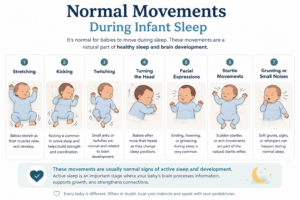
Adults spend most of the night in deeper, quieter sleep stages. Babies, especially newborns, spend a much larger proportion of their sleep in what researchers call active sleep, the infant equivalent of REM (Rapid Eye Movement) sleep. Newborns may spend more than half of their total sleep time in this active state. During the first months of life, this proportion gradually decreases as sleep matures.
During active sleep, babies commonly:
- Twitch their arms and legs
- Smile or frown
- Make sucking motions
- Open and close their eyes briefly
- Wiggle and squirm
- Change facial expressions
- Produce small sounds or grunts
To a parent, it can look as though the baby is waking up. In reality, they may be actually still be sleeping. This is one of the most common reasons parents accidentally wake a baby who was actually still asleep.
What Is Active Sleep?
Active sleep is an important developmental stage.
During this phase, the brain is highly active. Researchers believe active sleep plays a role in brain maturation, sensory processing, learning, and the development of neural connections. Infants enter active sleep much more quickly than adults and spend far more time in it during early life.
The movements seen during active sleep are not random. Studies suggest that many of these small twitches help the developing brain learn about the body and its movements. Signals generated by these movements contribute to the development of sensory and motor pathways.
In other words, some of the movements that seem disruptive to parents may actually be helping your baby’s nervous system develop.
Why Does My Baby Twitch During Sleep?
Twitching is one of the most common concerns among parents.
A baby’s hands may suddenly jerk. Their legs may kick. Their face may twitch briefly. These movements are usually short and occur most often during active sleep.
Researchers have found that sleep-related twitches are closely linked to sensorimotor development. These small movements provide feedback to the brain that helps build and refine movement control.
Normal sleep twitches:
- Are brief
- Occur mainly during sleep
- Stop when the baby wakes
- Affect different parts of the body at different times
- Are not associated with changes in breathing or skin color
Although they can appear dramatic, they are usually a normal part of infancy.
Stretching, Squirming, and Repositioning
Babies are surprisingly active sleepers.
Unlike adults, who typically stay in one position for long periods, babies frequently adjust their posture throughout the night.
You may notice your baby:
- Stretching their arms overhead
- Pulling their knees toward their chest
- Arching their back briefly
- Turning their head
- Scooting slightly across the mattress
- Lifting their legs repeatedly
These movements help babies find comfortable positions and are part of normal physical development.
As muscle strength increases during the first year, babies become more capable of repositioning themselves. What looks like restlessness is often simply the body exploring movement and comfort.
Developmental Milestones Can Increase Nighttime Movement
Many parents notice that sleep becomes more active around the time their baby learns a new skill.
This is not your imagination.
Research has found that the acquisition of new motor skills can temporarily increase movement during sleep and even contribute to more night waking. Babies who are learning to crawl, pull to stand, cruise, or walk often show increased nighttime activity.
Parents frequently report that their baby:
- Practices rolling during sleep
- Pushes onto hands and knees
- Pulls up in the crib
- Sits up unexpectedly
- Moves around the crib more than before
The developing brain appears to continue processing and consolidating these new motor skills during sleep.
In many cases, nighttime movement increases just before or shortly after a major milestone.
The Startle Reflex Can Make Babies Seem Restless
Newborns have several primitive reflexes that help them adapt to life outside the womb.
One of the most noticeable is the Moro reflex, often called the “startle reflex”.
A baby may suddenly throw their arms outward, open their hands, and then quickly bring their arms back toward their body. This can happen after a loud sound, a sudden sensation of falling, or sometimes seemingly for no reason at all.
The Moro reflex is normal in young infants and usually fades between approximately two and six months of age as the nervous system matures.
For parents unfamiliar with it, the movement can be alarming, especially when it happens during sleep.
Why Does My Baby Seem More Active at Night?
 There are several reasons babies may appear more active during nighttime sleep.
Sleep Cycles Are Shorter
Baby sleep cycles are much shorter than adult sleep cycles. As babies transition between sleep stages, movement often increases. You may see stretching, repositioning, brief vocalizations, or twitching.
More Time in Active Sleep
Young babies spend a significant proportion of sleep in active sleep, where movement is expected.
Rapid Brain Development
The first year of life is a period of extraordinary brain growth. Sleep plays a critical role in supporting this development, and many sleep movements are thought to reflect ongoing neurological maturation.
Should I Intervene When My Baby Is Moving?
One of the hardest lessons for parents is learning when not to intervene. A baby who wiggles, squirms, grunts, or briefly fusses may still be asleep. If parents immediately pick up, feed, rock, or stimulate the baby whenever movement occurs, they may accidentally interrupt a sleep cycle.
Before responding, pause and observe.
Ask yourself:
- Are the baby’s eyes closed?
- Are the movements brief?
- Does the baby settle again within a minute or two?
- Is the baby actually crying or simply making sleep noises?
Many babies move considerably between sleep cycles and then return to deeper sleep on their own.
Of course, if your baby is distressed, crying persistently, appears uncomfortable, or requires feeding, responding is appropriate.
When Should Parents Be Concerned?
Most baby sleep movements are normal. However, some situations deserve medical evaluation.
Contact your pediatrician if you notice:
- Repetitive rhythmic jerking that does not stop when the baby wakes
- Movements accompanied by breathing difficulties
- Changes in skin color, especially blue or gray discoloration
- Loss of responsiveness
- Stiffening episodes
- Significant asymmetry, where only one side of the body consistently moves differently
- Any movement that seems unusual, repetitive, or concerning to you
Parents know their babies best. If something feels significantly different from your baby’s normal behavior, seeking medical advice is always appropriate.
Understanding Movement Can Reduce Anxiety
Many parents lose sleep not because their baby is awake, but because they repeatedly check on normal movements that are part of healthy infant sleep.
For some families, technology can provide additional reassurance. A monitoring system that can distinguish routine movement from meaningful changes can help parents rest without feeling they must constantly watch their baby. Rather than notifying parents every time a baby stretches, changes position, or moves during active sleep, a well-designed monitoring system can allow families to rest while remaining informed about meaningful movement changes.
The goal is not to replace parental judgment, but to provide confidence. Parents should be able to sleep knowing that normal nighttime movement is expected, while still receiving reliable alerts if a situation truly requires their attention.
The Bottom Line
Babies are not supposed to sleep like adults.
In fact, much of what worries parents—twitching, stretching, kicking, squirming, grunting, and changing positions—is often a sign of healthy sleep and normal development.
Young infants spend a large portion of their sleep in active sleep, a stage associated with movement, brain development, and the formation of important neural connections. As babies grow and master new skills such as rolling, crawling, and walking, nighttime movement may temporarily increase even further.
While it can be surprising to watch, a moving baby is usually a normal baby.
Sometimes the best thing parents can do is simply watch, wait, and remember that growing brains are busy—even during sleep.