

Can Monitoring Devices and Smart Pillows Improve Your Well-being?
May 8, 2026
Why Does My Baby Move So Much During Sleep?
June 13, 2026
Summary
During the first year of life, baby sleep changes rapidly as feeding patterns, circadian rhythms, sleep cycles, physical development, and emotional development mature. Newborns typically sleep 14–17 hours per day but wake frequently because their small stomachs require regular feeding. Around 3–4 months, babies gradually begin learning the difference between day and night. Between 4 and 6 months, sleep cycles become more organized, while developmental milestones such as rolling, crawling, and standing can temporarily disrupt sleep. By 9–12 months, separation anxiety and attachment often play a greater role in nighttime waking. Although sleep generally becomes more predictable during the first year, frequent waking remains normal for many healthy babies. Consistent routines, exposure to daylight, and safe sleep practices can help support healthy sleep development.
During the first year of life, babies spend more time asleep than awake, yet sleep is one of the greatest sources of uncertainty for new parents. The questions often begin in the maternity ward and continue through countless night feeds, contact naps, and early-morning wake-ups. Is my baby sleeping enough? Why do they wake so often? Is this normal?
The first year of life is a period of extraordinary growth, and sleep changes rapidly alongside it. A newborn’s sleep is very different from an adult’s sleep. Babies are born with immature sleep-wake rhythms, shorter sleep cycles, and feeding needs that require them to wake frequently. Over time, sleep becomes more organized, but the process is gradual and often uneven.
A newborn may sleep for many hours across a 24-hour period, but that sleep is divided into short stretches. Some sleep occurs during the day, some at night, and the timing often seems random to exhausted parents.
During the first year, sleep is shaped by feeding, brain development, physical milestones, emotional growth, and the gradual emergence of the body’s internal clock. Understanding these factors can help parents know what is normal, what to expect, and how to support healthy sleep habits from the very beginning.
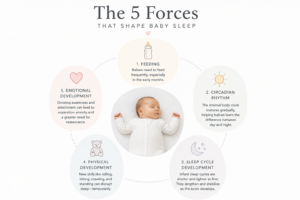
The Five Forces That Shape Sleep During the First Year
Although every baby is different, most sleep changes during infancy can be explained by five major influences.
1. Feeding
Feeding and sleep are closely connected during infancy. Because newborns have small stomachs and rapid growth needs, they need to feed frequently, often every two to four hours. As a result, frequent waking is usually a normal feeding pattern, rather than a sleep problem.
As babies grow, they can consume more milk at each feeding and stay awake for longer periods. This gradually allows for longer stretches of sleep. Since feeding needs, growth rates, temperament, and development vary from one baby to another, sleep patterns vary too.
During the first year, sleep is not just about rest. It is also about supporting growth, nutrition, and healthy development. A baby who wakes to feed is often doing exactly what their body needs. This does not necessarily make the nights easier. Many parents spend the first weeks feeling as though they have barely fallen asleep before the next feed arrives. Sleep deprivation and exhaustion during this period is common and understandable.
2. Circadian Rhythm
Newborns are not yet governed by a fully developed circadian rhythm—the internal biological clock that helps adults feel awake during the day and sleepy at night. Newborns are not born knowing the difference between day and night.
Over the first months of life, exposure to daylight, darkness, social interaction, and daily routines helps their internal body clock mature. As this happens, sleep often becomes more predictable.
3. Sleep Cycle Development
Infant sleep cycles are shorter and less stable than adult sleep cycles. As babies grow, their sleep architecture gradually matures, allowing longer stretches of sleep.
4. Physical Development
Rolling, sitting, crawling, standing, and walking all affect sleep. Babies are eager to train their new skill, taking time from a nap that seemed standardized, or getting up in the middle of the night instead of soothing themselves back to sleep. Parents are often surprised to discover that developmental progress can temporarily worsen sleep.
5. Emotional Development
As babies become more aware of their caregivers and surroundings, attachment and separation anxiety begin to influence sleep. The baby who once fell asleep easily may suddenly protest when a parent leaves the room.
These five forces influence sleep throughout the first year, although their relative importance changes as babies grow.
How Much Sleep Do Babies Need?
General recommendations suggest:
| Age | Total Sleep Per 24 Hours |
| 0–3 months | 14–17 hours |
| 4–12 months | 12–16 hours (including naps) |
That said, sleep needs vary considerably from one baby to another. These figures should be viewed as guides rather than strict targets.
A healthy baby who sleeps slightly less than average is not automatically sleep deprived. Likewise, a baby who sleeps more than average is not necessarily oversleeping.
Growth, feeding, mood, alertness, and developmental progress provide a more complete picture than sleep duration alone.
Newborn Sleep: 0–3 Months
During the first three months, the newborn brain is focused on growth, feeding, and adaptation to life outside the womb.
Sleep is highly fragmented, with many babies sleeping for one to three hours at a time before waking to feed. During this period, feeding needs and the feeding pattern drive sleep and sleep patterns (if any).
Because newborns have not yet developed a mature circadian rhythm, they do not consistently distinguish day from night. A baby may sleep peacefully all afternoon and then seem wide awake at midnight. This pattern is normal.
The newborn period is often the most challenging for parents. Many parents find themselves measuring time not in hours, but in feedings. Days and nights can blur together, especially when sleep comes in short stretches.
Why Newborns Wake So Often
Parents often assume frequent waking is a sign that something is wrong. In reality, waking is usually expected.
Common reasons include:
- hunger;
- diaper changes;
- physical discomfort;
- normal sleep cycle transitions;
- the need for comfort and regulation.
A newborn who wakes every two or three hours is usually behaving exactly as nature intended.
What Is Normal Sleep for a Newborn aged 0-3 months?
It is generally normal for newborns to:
- sleep in short stretches;
- wake frequently to feed;
- fall asleep while feeding;
- have irregular sleep patterns;
- sleep at unexpected times during the day and night.
Active Sleep: Why Babies Move and Make Noises
Many parents are surprised by how restless sleeping newborns can appear.
A newborn may twitch, smile, suck, grimace, grunt, move their arms, or briefly open their eyes while remaining asleep. This often occurs during active sleep.
Active sleep is a normal stage of infant sleep and occupies a larger proportion of a newborn’s sleep than it does in adults.
Because babies spend so much time in active sleep, parents may mistakenly think they are awake when they are actually sleeping. However, not every movement requires intervention. Sometimes waiting a moment before picking up a baby reveals that they are still asleep and capable of settling naturally into the next sleep cycle.
Sleep from 3–4 Months
Around three to four months, many parents begin to notice the first signs of a pattern emerging. Nights may become slightly longer, wake windows easier to predict, and daytime sleep a little more structured. This change reflects the gradual development of the baby’s circadian rhythm.
Sleep may become somewhat more predictable. Nighttime stretches may lengthen. Daytime wake windows may become easier to recognize.
This change reflects the gradual maturation of the circadian rhythm.
Parents often notice that their baby is becoming more responsive to environmental cues such as light, darkness, activity, and routine.
How Parents Can Support Circadian Rhythm Development
Although circadian rhythms develop naturally, parents can help support the process.
During the day:
- expose babies to natural daylight;
- keep curtains open;
- talk, play, and interact normally;
- allow daytime activity, stimulation and noise.
In the evening:
- gradually reduce stimulation;
- dim household lighting;
- lower noise levels;
- create a calmer environment.
At night:
- keep feeds quiet and calm;
- use minimal lighting;
- avoid turning nighttime wakings into playtime.
These simple habits help babies begin associating daytime with activity and nighttime with sleep.
Sleep from 4–6 Months
Between four and six months, sleep cycles mature and sleep becomes more structured. Babies begin spending longer periods asleep at night and may develop more predictable nap schedules. For some families, this is the first period when sleep feels a little more manageable. For others, improvements are more gradual. Both experiences can be normal.
However, this period is sometimes associated with the so-called “4-month sleep regression.”
To parents who appreciate longer night sleep periods or predictable nap times, this may feel like a regression, but in fact it is rather a reorganization of sleep
As sleep cycles mature, babies become more aware of transitions between stages of sleep. Some wake briefly and return to sleep. Others wake fully and signal for help. This developmental shift can make sleep temporarily seem worse even though the sleep system is becoming more mature.
Many babies also begin responding positively to consistent sleep cues and bedtime routines during this stage.
Sleep from 6–9 Months
From six to nine months, physical development becomes one of the strongest influences on sleep. Babies are eager to practice their new skills, sometimes at the most inconvenient times. A baby who has just learned to crawl may be far more interested in practicing than in settling down for a nap.
Many parents discover a baby happily practicing crawling skills in the crib instead of sleeping.
Others find their baby repeatedly pulling to stand when they wake up in the middle of the night and then crying because they do not yet know how to sit back down.
Developmental milestones often create temporary sleep disruptions. Just when parents feel they have finally figured sleep out, a new skill often changes the picture again. Fortunately, these phases usually improve as new skills become more familiar.
Sleep from 9–12 Months
Toward the end of the first year, emotional development begins to play a larger role.
Babies become increasingly aware of the people they love most. They understand that parents can leave—and they may not like it. This growing awareness often contributes to separation anxiety. A baby who previously drifted off happily may suddenly want reassurance that their favourite people are still close by.
A baby who previously settled easily may suddenly cry when a caregiver leaves the room. Bedtime resistance may increase. Night wakings may become more emotionally driven than feeding-driven.
This stage can be frustrating for parents. It can feel particularly discouraging if sleep had recently improved. However, this behaviour reflects emotional development rather than a step backwards.
What Does Sleeping Through the Night Mean?
Many parents eagerly wait for the day their baby sleeps through the night.
However, the phrase itself is surprisingly vague.
For researchers, sleeping through the night may mean a continuous stretch of five or six hours.
For parents, it often means sleeping from bedtime until morning without needing assistance.
These are very different definitions.
Some babies begin sleeping longer stretches early in infancy. Others continue waking regularly beyond six months.
Night waking alone does not determine whether sleep is healthy. The broader context—including feeding, growth, development, and safety—matters far more.

Why Babies Wake at Night
Even babies who have previously slept well may wake at night. There are many reasons for that, and parents gradually learn to recognize and address them.
Hunger
During the early months, hunger is one of the most common reasons for waking. Throughout the first year, growth spurts can temporarily increase nighttime feeding needs.
Sleep Cycle Transitions
All humans briefly transition between sleep cycles. Babies are simply more likely to wake fully during these transitions, especially if they are acquiring a new movement skill. A baby learning to crawl may practice crawling when they should be transitioning to the next sleep cycle.
Separation Anxiety
Older infants may wake because they want reassurance that caregivers remain nearby.
Illness and Discomfort
Teething, congestion, illness, and environmental discomfort can all affect sleep.
Is My Baby Sleeping Too Little?
Many parents compare their baby’s sleep to charts, apps, books, or other babies. While sleep recommendations provide useful guidance, healthy sleep can look different from one child to another.
A baby who sleeps slightly less than average but feeds well, grows appropriately, and is alert when awake may be getting exactly the amount of sleep they need.
On the other hand, persistent sleep difficulties combined with poor feeding, poor growth, unusual irritability, or excessive sleepiness deserve discussion with a healthcare professional.
The goal is not to chase a perfect number of hours. The goal is to understand your baby’s overall wellbeing.
When Should Parents Be Concerned About Baby Sleep
Most variation in infant sleep is normal.
However, parents should contact a healthcare professional if they notice:
- breathing difficulties during sleep;
- unusual lethargy;
- poor feeding;
- poor weight gain;
- difficulty waking the baby;
- sudden sleep changes accompanied by illness;
- any symptom that raises concern.
Parents know their babies better than anyone. Concerns should never be dismissed simply because a behavior falls within a broad range of normal.
Naps During the First Year
Naps contribute significantly to total daily sleep. While newborn naps are often unpredictable and scattered throughout the day, as babies grow, they typically become more organized.
Many older infants settle into a pattern of two or three regular naps. Parents appreciate this rhythm, because they can schedule their own rest or chores or me-time around these naps. You should know that they won’t last for ever: as infants grow up, they gradually drop naps until many are left with a single midday nap.
How to Encourage Healthy Nap Habits
Parents cannot force sleep, but they can create conditions that support it. Helpful strategies include:
- Watching for sleepy cues, to put baby down for a nap.
- Avoiding overtiredness and therefore overexcitement, which can disturb naps.
- Maintaining regular routines, which help babies develop a daily sleep rhythm.
- Providing opportunities for daytime sleep, especially during early ages.
- Exposing babies to natural daylight during the day, to support circadian rhythm development.
The goal is not perfection, but consistency.
Creating a Bedtime Routine
A bedtime routine does not need to be elaborate. In fact, simple routines are often the most effective.
The purpose of a bedtime routine is not to make a baby fall asleep instantly. The purpose is to create predictable signals that nighttime sleep is approaching. These signals become especially helpful as babies grow older and begin to anticipate what comes next. The routine itself matters less than the consistency with which it is repeated.
A bedtime routine might include:
- a warm bath;
- feeding;
- changing into sleepwear;
- reading a short story;
- singing a lullaby;
- cuddling quietly;
- dimming the lights.
Again, what matters most is consistency. When similar events occur in the same order each evening, babies gradually learn to associate those cues with sleep.
At the same time, maintaining a routine should not mean putting family life on hold. An occasional dinner out, lunch with friends, family gathering, or date night is unlikely to undo healthy sleep habits.
While babies generally benefit from predictable routines, occasional changes are a normal part of life. If the usual pattern is disrupted, try to keep the environment calm and reassuring. Babies often take their cues from the adults around them, so a relaxed caregiver can help them adapt more easily to temporary changes.
What matters most is the overall rhythm of daily life, not perfect adherence to a schedule every single day.
Safe Sleep Remains Essential All Year
Regardless of how a baby’s sleep develops, safe sleep recommendations remain important throughout infancy. This is true even during difficult periods when parents are exhausted or tempted to relax the rules for a short nap. Safe sleep practices help reduce the risk of sleep-related infant deaths and accidental suffocation, and they apply to every sleep, whether it happens during the day or at night.
- Babies should always be placed on their backs for sleep on a firm, flat sleep surface designed for infants.
- The sleep area should remain free of loose blankets, pillows, stuffed animals, bumper pads, and other soft objects.
- Room sharing without bed sharing is recommended during early infancy.
Safe sleep practices apply to naps as well as nighttime sleep.
Key Takeaways
If there is one thing parents should remember, it is that baby sleep is constantly changing. Just as families adapt to one stage, another often arrives. This can be tiring, frustrating, and sometimes confusing. Yet most changes in infant sleep reflect growth and development rather than problems that need to be fixed.
- Baby Sleep Is Not Broken Adult Sleep. Infant sleep follows different biological rules than adult sleep.
- Feeding Shapes Sleep During the First Year. Many nighttime wakings are linked to feeding needs rather than sleep problems.
- Sleep Develops in Stages, Not in a Straight Line. Periods of progress are often followed by temporary disruptions.
- Parents Can Help Babies Learn Day from Night. Daylight, darkness, and predictable routines support circadian rhythm development.
- Frequent Waking Is Often Normal. Waking is a common part of healthy infant development.
- Safe Sleep Matters at Every Age. Safe sleep recommendations remain important throughout the entire first year.