

How Babies Breathe: What’s Normal, What’s Not, and When to Seek Help
June 14, 2026
Is It Normal for My Baby to Sweat During Sleep?
June 20, 2026
Summary
Irregular breathing is common in newborns. Healthy babies may breathe faster, slower, take deeper breaths, sigh, or briefly pause during sleep and wakefulness. These patterns are usually normal, but prolonged pauses, breathing difficulty, or signs of illness require medical attention.
You just brought your newborn home. Your baby seems to spend most of the day sleeping, but you may find yourself spending a surprising amount of time watching them breathe. Many parents check their baby’s chest before going to sleep, listen for unusual sounds, or wake during the night to make sure everything looks normal.
Part of the reason is that newborn breathing often looks irregular. During the first year of life, the systems that control breathing are still maturing. A baby may breathe quickly for several breaths, slow down moments later, pause briefly, and then return to a different rhythm. These changes can happen while asleep, awake, feeding, or resting quietly.
In most healthy newborns, this breathing variability is a normal part of development. The important question is knowing when irregular breathing is expected and when it may be a sign of illness, apnea, or breathing difficulty.
How Fast Should My Newborn Breathe?
A newborn’s breathing rate is naturally faster than an adult’s. The following table presents typical breathing rates for your baby during their first year.
| Age | Typical Breaths Per Minute |
| Newborn (0–1 month) | 30–60 |
| 1–6 months | 30–50 |
| 6–12 months | 25–40 |
Breathing rates may temporarily increase during crying, feeding, excitement, or active sleep. The most useful breathing rate is the one measured while your baby is calm or sleeping.
What Is the Right Way to Count My Baby’s Breathing Rate?
If you are concerned about your baby’s breathing:
- Wait until your baby is calm or asleep.
- Watch the chest or abdomen rise and fall.
- Count one rise and fall as one breath.
- Count for a full 60 seconds.
Because newborn breathing is often irregular, counting for only 15 or 30 seconds may not provide an accurate result.
What Is Normal Newborn Breathing While Sleeping?
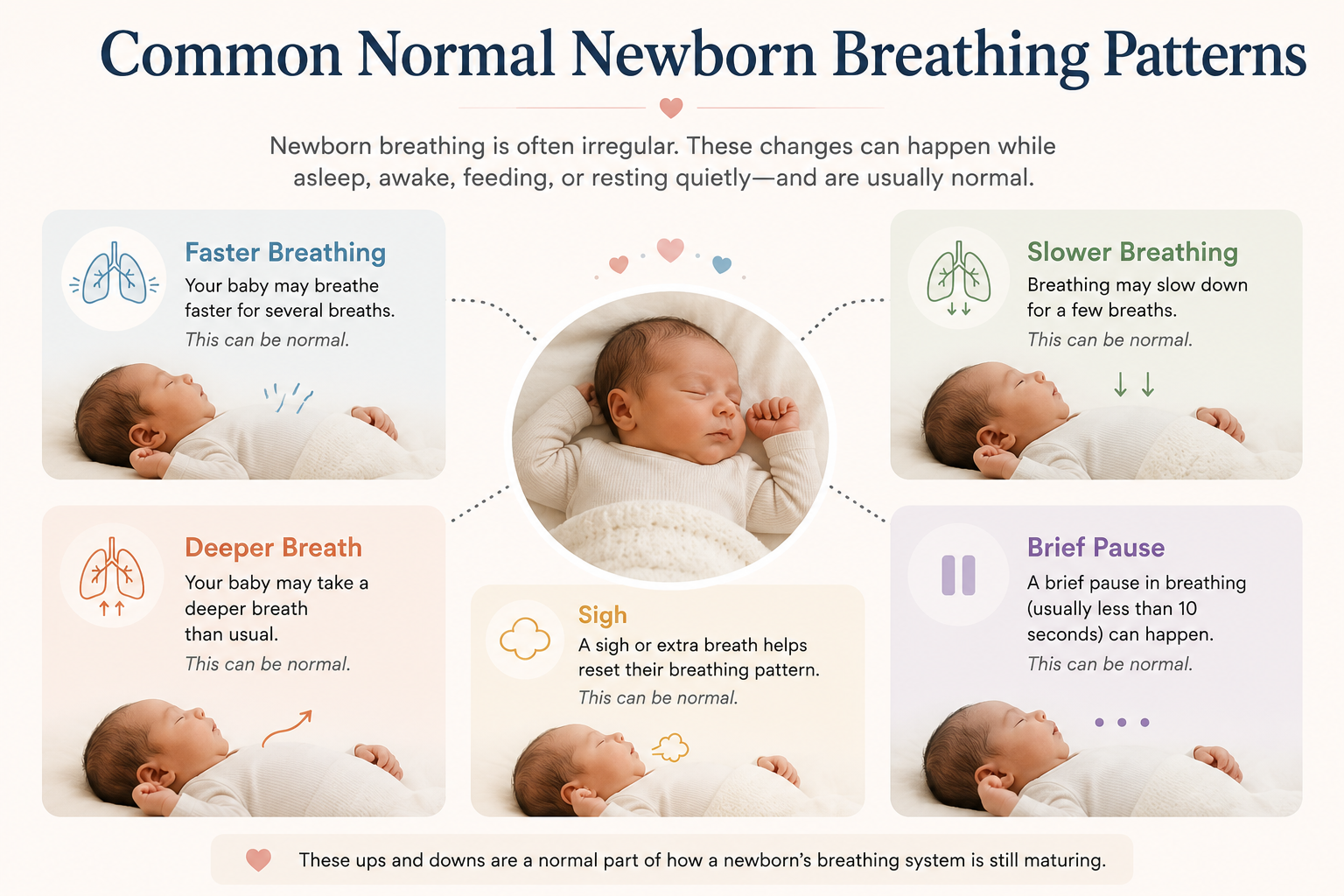
Sleep is when many parents first notice breathing irregularities. During sleep, newborns naturally move between different sleep states, and breathing patterns may change. Deep breaths and sighs help keep the lungs expanded and reopen tiny air sacs that may partially collapse during normal breathing.
It is common to observe:
- Faster breathing followed by slower breathing. Newborn breathing control is still maturing, making the rhythm less consistent than in adults.
- Changes in breath depth. Occasional deeper breaths help maintain lung expansion.
- Occasional sighs. Sighs help reopen tiny air sacs within the lungs.
- Brief pauses lasting a few seconds. Brief pauses can occur because the systems that regulate breathing are still maturing.
Is It Normal for My Newborn to Breathe Irregularly While Awake?
Yes. Breathing patterns can also change while a baby is awake, feeding, crying, stretching, or transitioning between activity and rest.
This happens because a newborn’s breathing is closely linked to their level of activity. Feeding, crying, movement, excitement, and even becoming drowsy can temporarily change breathing rate and depth. In addition, the parts of the brain that regulate breathing are still maturing, making newborn breathing less consistent than adult breathing.
Irregular breathing is therefore not limited to sleep. It may be noticeable throughout the day and is often a normal part of early development.
Why Is My Newborn Breathing Fast While Sleeping?
Brief periods of faster breathing during sleep are often normal.
Newborn breathing naturally changes during different sleep stages. A baby may breathe faster for several seconds, slow down again, and then return to a different rhythm. This variation is one reason why newborn breathing can look irregular and sometimes worrying.
Fast breathing becomes more concerning when it remains consistently elevated while your baby is calm or sleeping. As a general guide, the following breathing rates may be considered unusually fast when measured at rest:
| Age | Breathing Rate That May Be Considered Fast at Rest |
| Newborn (0–1 month) | More than 60 breaths per minute |
| 1–6 months | More than 50 breaths per minute |
| 6–12 months | More than 40 breaths per minute |
These numbers apply when your baby is calm or asleep. Breathing rates measured during crying, feeding, or active movement are often higher and are usually less useful.
Contact your healthcare provider if your baby’s breathing remains persistently faster than expected for their age, particularly if it is accompanied by:
- Fever
- Poor feeding
- Unusual sleepiness
- Reduced responsiveness
- Cough or congestion
- Chest retractions
- Persistent nostril flaring
Fast breathing can sometimes be an early sign of illness and should be evaluated if it does not improve or occurs together with other concerning symptoms.
Can My Baby’s Breathing Be Too Slow?
Newborn breathing sometimes slows briefly or pauses for a few seconds before resuming.
These short pauses are often part of normal breathing variability. Short pauses in breathing are common in healthy newborns and are not the same as apnea.
Apnea is a pause in breathing that lasts about 20 seconds or longer, or a shorter pause that is accompanied by color changes, limpness, or reduced responsiveness.
Seek medical attention if your baby:
- Stops breathing for about 20 seconds or longer
- Turns blue, gray, or unusually pale
- Becomes limp or unresponsive
- Does not quickly resume normal breathing
Can My Baby’s Breathing Be Too Irregular?
In most healthy newborns, irregular breathing is expected.
Breathing may speed up, slow down, and vary in depth from one minute to the next. This is often most noticeable during sleep but may also occur while a baby is awake.
Irregular breathing deserves closer attention if it occurs together with:
- Persistent fast breathing
- Fever (38.0°C / 100.4°F or higher in babies under 3 months)
- Other signs of illness, such as cough, congestion, vomiting, or reduced responsivenessPoor feeding
- Difficulty waking
- Signs of respiratory distress
- Prolonged breathing pauses
These symptoms are more important than the irregularity itself.
Why Is My Newborn Breathing Hard While Sleeping?
Breathing that appears genuinely hard or labored is not considered normal. Normal baby breathing, even irregular, is effortless. If your baby is struggling to breathe, this needs prompt medical evaluation and attention.
Warning signs include:
- Skin pulling in between the ribs
- Skin pulling in at the base of the neck
- Persistent nostril flaring
- Grunting with each breath
- Difficulty feeding because of breathing problems
If your baby appears to be working hard to breathe, contact your pediatrician promptly. If you cannot reach them and your baby appears distressed, seek urgent medical care.
When Should my Baby’s Noisy Breathing Concern Me?
Newborns can be surprisingly noisy. Normal breathing sounds may include soft snuffles, occasional sighs and squeaks, mild congestion sounds and small noises when changing position.
These sounds are usually caused by narrow nasal passages and normal newborn breathing patterns.
Certain sounds may indicate a breathing problem in your newborn, particularly if they occur repeatedly or are accompanied by respiratory distress:
- Persistent Grunting: Persistent grunting with every breath may indicate respiratory distress and should be evaluated promptly.
- Stridor: A harsh, high-pitched sound when breathing in may indicate narrowing of the upper airway.
- Wheezing: A whistling sound during breathing may suggest narrowing of the lower airways.
Seek medical advice if noisy breathing occurs together with:
- Chest retractions and laborious breathing
- Persistent fast breathing
- Color changes
- Poor feeding
Noisy breathing by itself is often harmless. What matters most is whether it occurs together with signs that your baby is struggling to breathe.
Bottom Line: When Should I Worry About My Baby’s Breathing and Seek Immediate Medical Help?
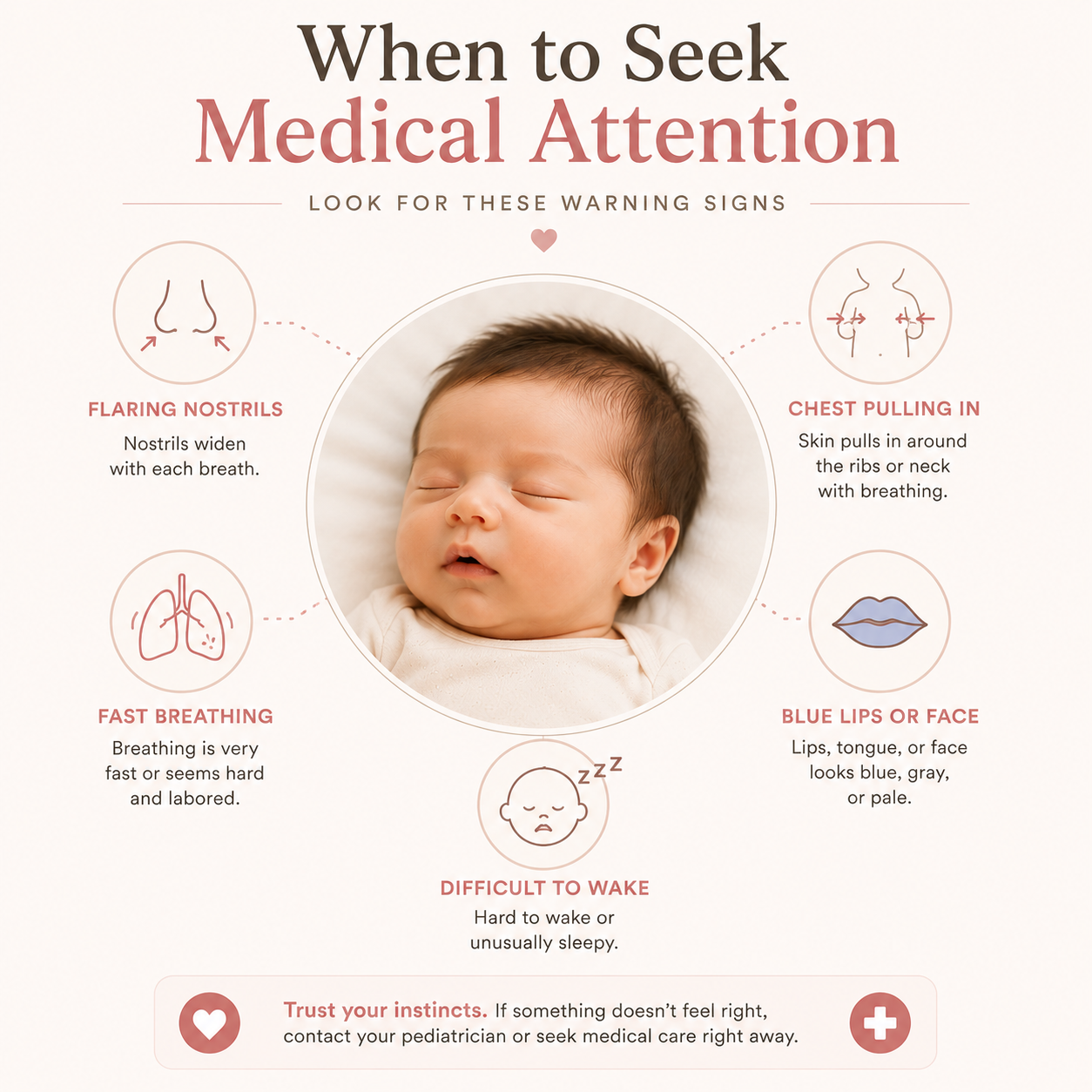
Seek urgent medical attention if your baby:
- Stops breathing for about 20 seconds or longer
- Turns blue, gray, or pale
- Is struggling to breathe
- Has persistent rapid breathing and appears distressed
- Shows chest retractions
- Has persistent nostril flaring
- Becomes difficult to wake
- Feeds poorly because of breathing problems
These signs are more important than whether breathing is perfectly regular.
Most newborn breathing irregularities are a normal part of early development. Breathing may speed up, slow down, vary in depth, or briefly pause during both sleep and wakefulness.
The most important question is not whether breathing is perfectly regular, but whether your baby appears comfortable and well. Persistent fast breathing, prolonged breathing pauses, respiratory distress, or signs of illness should always be evaluated by a healthcare professional.