

When Do Babies Develop a Circadian Rhythm? Understanding Your Baby’s Internal Clock
July 12, 2026
Why Does My Baby Wake Up So Often at Night? Common Causes by Age
July 12, 2026
Summary
Baby sleep stages change rapidly during the first years of life. Newborns cycle between Active Sleep and Quiet Sleep before gradually developing the REM and Non-REM sleep pattern seen in older children. Each stage supports healthy brain development, physical growth, and learning, while explaining the movements, breathing patterns, and sounds parents observe during sleep.
During the first months of life, newborn sleep follows a unique pattern designed to support rapid brain growth and neurological development. Unlike adults, babies have shorter sleep cycles and spend much more time in active sleep, the developmental stage that gradually evolves into REM (Rapid Eye Movement) sleep.
As your baby grows, their sleep stages become more organized, developing into the familiar REM and Non-REM (NREM) sleep cycles seen in older children and adults. This natural progression changes your baby’s sleep patterns over time, helping explain why newborn sleep often includes frequent movement, irregular breathing, brief awakenings, and shorter sleep cycles before gradually becoming longer and more consolidated.
How Does a Baby Sleep Cycle Work?
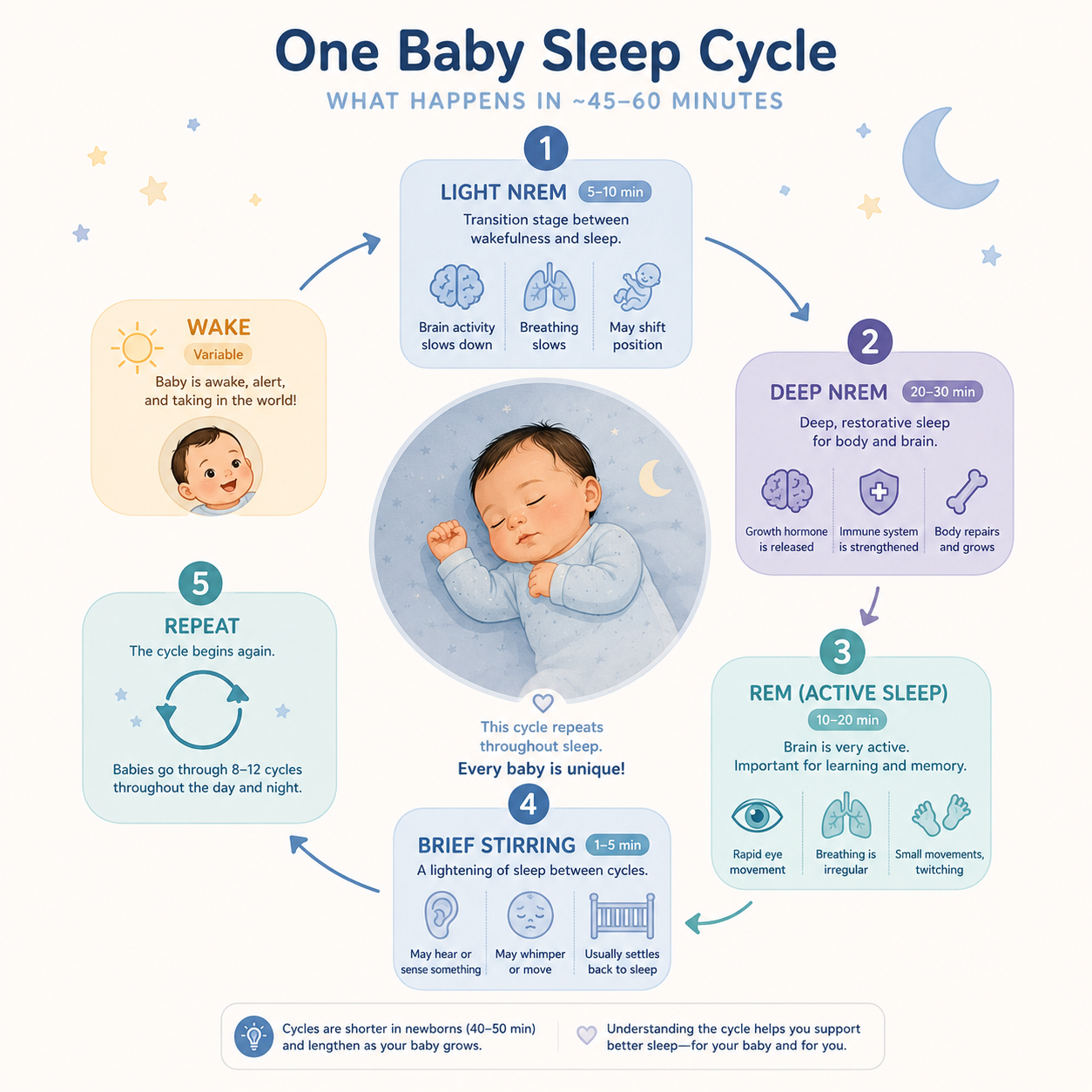
Baby sleep is made up of repeating sleep cycles rather than one continuous period of rest. During each baby sleep cycle, your baby’s brain moves through different sleep stages, each characterized by distinct patterns of brain activity, breathing, heart rate, muscle tone, and body movement. These baby sleep stages repeat throughout the night, supporting both healthy brain development and physical growth.
Unlike adults, newborns have short sleep cycles, typically lasting 40–50 minutes. An adult sleep cycle usually lasts 90–120 minutes.
In the first months, babies cycle between:
Active Sleep → Quiet Sleep → Active Sleep → Brief awakening (sometimes) → Next baby sleep cycle
As the brain matures, these sleep stages gradually become organized into the familiar pattern of:
Light NREM Sleep → Deep NREM Sleep → REM Sleep → Brief transition → Next cycle
Because babies complete so many short sleep cycles during the night, parents often notice movement, changes in breathing, or brief awakenings every 40–60 minutes. In many cases, these are simply normal transitions between sleep stages rather than signs that something is wrong.
Active Sleep: The Newborn Version of REM Sleep
During the newborn stage, sleep specialists refer to this phase as Active Sleep, the developmental form of REM sleep in newborns. Although Active Sleep closely resembles REM sleep, a newborn’s brain has not yet developed the fully mature REM and Non-REM (NREM) sleep stages seen later in infancy. Newborns spend about 50% of their total sleep in Active Sleep, making it the most common stage of newborn sleep during the first weeks of life.
What happens in your baby’s body?
This is the stage in which parents observe the greatest amount of activity.
 You may notice:
- Rapid eye movements beneath closed eyelids, a defining feature of REM sleep
- Twitching of the face, fingers, hands, or legs during Active Sleep
- Stretching and brief body movements as your baby transitions within the sleep stage
- Smiles or changing facial expressions during newborn REM-like sleep
- Sucking movements, which are common during Active Sleep
- Small noises, grunts, squeaks, or brief cries while your baby remains asleep
- Irregular breathing, including short pauses that are normal during newborn sleep
- Natural fluctuations in heart rate as brain activity changes throughout the sleep cycle
- Slight changes in skin temperature as your baby’s metabolism varies during sleep
Despite all this activity, your baby is asleep during the active sleep phase. Observe if they have their eyes open and are really awake, and if they are still asleep, do not rush to pick them up.
What is happening in your newborn’s brain?
Active Sleep is thought to play a critical role in early development by helping the baby’s brain:
- Build billions of neural connections, supporting rapid baby brain development
- Process sensory experiences gathered while your baby is awake
- Develop vision and hearing pathways, which are essential during early infancy
- Organize early memory and learning, helping the developing brain retain new experiences
- Support overall neurological development and brain maturation, one of the primary functions of REM sleep in babies
This unusually high proportion of Active Sleep reflects the remarkable pace of brain development during early infancy.
Quiet Sleep: the Beginning of Non-REM Sleep
 Quiet Sleep is the calmer stage of newborn sleep and gradually develops into the different levels of Non-REM sleep seen in older children. During the quiet sleep phase, your baby’s body focuses more on physical recovery than on brain stimulation.
What happens in your baby’s body?
Parents will usually notice a much calmer baby during quiet sleep.
Typical signs include:
- Slow, regular breathing, which is typical of Quiet Sleep and later deep Non-REM (NREM) sleep
- Steady heart rate, reflecting your baby’s calmer physiological state
- Very little body movement, with only occasional stretching or repositioning
- Few or no vocalizations, making this one of the quietest stages of baby sleep
- A baby who is harder to wake, as sleep becomes deeper and more restorative
- More stable body temperature, although maintaining a safe sleep environment remains important throughout the night
Because movement is minimal, many parents mistakenly believe quiet sleep is the only “good” sleep. In reality, both Active Sleep and Quiet Sleep are essential for healthy development.
What is happening in the brain?
Quiet Sleep allows the body to recover and grow.
During this stage:
- Growth hormone is released, supporting your baby’s rapid physical growth and development.
- Cells repair and tissues regenerate, helping the body recover during deep Non-REM sleep.
- The immune system is strengthened, supporting your baby’s natural defenses.
- Energy stores are replenished, preparing your baby for periods of wakefulness, feeding, and activity.
- The brain consolidates memories and processes information gathered while your baby was awake, supporting healthy learning and brain development.
When Do REM and Non-REM Sleep Appear?
Between 2 and 6 months of age, your baby’s sleep stages and sleep cycles begin changing rapidly as the brain matures. Instead of alternating mainly between Active Sleep and Quiet Sleep, your baby’s sleep pattern gradually develops into the familiar REM (Rapid Eye Movement) and Non-REM (NREM) sleep stages seen in older children and adults.
During this period, baby sleep cycles also become longer, increasing from around 40–50 minutes in the newborn period to approximately 60 minutes by the end of the first year. Another important milestone is the order in which your baby enters the different sleep stages.
Newborns typically begin a sleep cycle in Active Sleep (REM-like sleep). As babies grow, they increasingly begin each sleep cycle in Non-REM sleep, progressing into REM sleep later in the cycle—the same pattern found in older children and adults.
This maturation of baby sleep helps explain why many older babies fall into a deep, quiet sleep soon after bedtime and gradually develop longer, more consolidated periods of nighttime sleep.
Light Non-REM Sleep
Light Non-REM (NREM) sleep is the first stage of Non-REM sleep and acts as the transition between wakefulness and deep sleep. During this stage, your baby’s body begins to relax while the brain prepares for deeper, more restorative sleep.
What happens in your baby’s body?
During this stage you may observe:
- Regular, slower breathing as your baby settles into Light Non-REM (NREM) sleep
- Reduced body movement, with fewer twitches than during REM sleep
- Occasional position changes or gentle stretching, which are normal during this stage of the baby sleep cycle
- A gradually slowing heart rate as the body prepares for deeper, more restorative sleep
- Brief stirring or partial arousals before settling again, a common transition between baby sleep stages
Because sleep remains relatively light, babies can still wake fairly easily if they are hungry, uncomfortable, or disturbed by noise.
What is happening in your baby’s brain?
During Light Non-REM (NREM) sleep, brain activity gradually slows as your baby’s body prepares for deep sleep, the most restorative stage of the baby sleep cycle. As your baby’s sleep patterns mature, this stage becomes more stable, making it easier to transition between sleep stages without fully waking and helping nighttime sleep become longer and more consolidated.
Deep Non-REM Sleep
Deep Non-REM (NREM) sleep is the deepest and most restorative stage of the baby sleep cycle. During deep sleep, your baby’s body focuses on physical growth, tissue repair, and immune function, while the brain enters its quietest state of activity. This stage usually occupies the middle portion of each sleep cycle before the brain gradually transitions into REM sleep, where brain activity becomes much higher again.
What happens in your baby’s body?
During deep sleep, parents commonly observe:
- Slow, rhythmic breathing, a hallmark of deep Non-REM (NREM) sleep
- Very little body movement, making this the quietest stage of the baby sleep cycle
- A stable heart rate as your baby’s body enters its most restorative state
- Few or no sounds, with minimal stirring or vocalizations
- Consistent body temperature, although babies still rely on a safe sleep environment to avoid overheating
- A baby who is difficult to wake, because deep sleep is the least responsive stage of baby sleepThis is often the quietest period displayed on a baby monitor.
What is happening in your baby’s brain?
Deep Non-REM (NREM) sleep is the most restorative stage of the baby sleep cycle and is essential for your baby’s physical growth and development. During deep sleep, the body focuses on repair, recovery, and growth, while the brain remains in its quietest state.
During deep Non-REM sleep:
- Growth hormone reaches its highest levels, supporting your baby’s rapid physical growth.
- Tissue repair and cell regeneration take place, helping the body recover and develop.
- The immune system is strengthened, supporting your baby’s natural defenses against illness.
- Energy stores are replenished, preparing your baby for feeding, movement, and learning during wakefulness.
Baby Sleep Stages by Age
Birth to 2 Months: Newborn Sleep Stages
During the first two months of life, newborn sleep is dominated by Active Sleep and Quiet Sleep, rather than the fully developed REM and Non-REM sleep stages seen later in infancy.
During this period:
- Newborn sleep cycles last approximately 40–50 minutes.
- About 50% of a newborn’s sleep is spent in Active Sleep (REM-like sleep).
- Frequent movement, twitching, sounds, facial expressions, and irregular breathing are normal during newborn sleep.
- Brief awakenings between sleep cycles are common, especially when babies need to feed.
Around 2–3 Months: Baby Sleep Becomes More Organized
Between two and three months, your baby’s sleep patterns begin changing as the circadian rhythm develops, helping them gradually distinguish between day and night.
During this stage:
- Baby sleep cycles become more predictable.
- Active Sleep gradually begins transitioning into REM sleep.
- Quiet Sleep starts developing into Non-REM sleep.
- Nighttime sleep slowly becomes more consolidated, although frequent awakenings are still normal.
Around 4–6 Months: REM and Non-REM Sleep Develop
Between four and six months, your baby’s sleep architecture changes significantly.
During this stage:
- REM and Non-REM (NREM) sleep become clearly established.
- Baby sleep cycles lengthen to around 60 minutes.
- Most babies begin each sleep cycle with Non-REM sleep before transitioning into REM sleep.
- Longer stretches of nighttime sleep become more common, although every baby develops at their own pace.
Around 6–12 Months: Deep Sleep Increases
During the second half of the first year, Deep Non-REM (NREM) sleep occupies a larger portion of the night.
Parents often notice:
- Longer periods of quiet, still sleep
- Slower and more regular breathing
- Less twitching and fewer random body movements
- More predictable baby sleep cycles
- Longer stretches of uninterrupted nighttime sleep
Although REM sleep gradually represents a smaller percentage of total sleep, it remains essential for brain development, learning, and memory.
Toddler Years and Beyond: Adult Sleep Patterns Begin to Form
As toddlers grow, baby sleep gradually evolves into the adult pattern.
By this stage:
- Sleep cycles continue lengthening until they reach approximately 90 minutes.
- REM and Non-REM sleep follow the same sequence seen in adults.
- Sleep becomes more consolidated during the night.
By around 5 years of age, the overall organization of sleep stages closely resembles adult sleep, although brain development and sleep maturation continue throughout childhood and adolescence.
How Much REM Sleep Do Babies Need?
| Age | Approximate REM Sleep |
| Newborn | ~50% of total sleep |
| Around 6 months | ~35–40% |
| Around 1 year | ~30% |
| Adult | ~20–25% |
The gradual reduction in REM sleep is a normal part of baby brain development and sleep maturation. During early infancy, babies spend much more time in REM sleep because their brains are rapidly building new neural connections and processing an enormous amount of new sensory information. As your baby grows, the pace of brain development gradually slows, allowing deep Non-REM (NREM) sleep to occupy a larger portion of the baby sleep cycle, supporting physical growth, tissue repair, immune function, and overall healthy development.
What Baby Sleep Stages Look Like on a Baby Monitor
If you use a baby monitor to track your baby’s sleep, you may notice that their breathing, movement, heart rate, body temperature, and even the sounds they make change repeatedly throughout the night. These changes often correspond to the different baby sleep stages and sleep cycles rather than indicating poor-quality sleep or frequent waking.
For example, during Active Sleep or REM sleep, babies are more likely to twitch, stretch, smile, make small noises, and breathe irregularly. During Deep Non-REM (NREM) sleep, breathing becomes slower and more rhythmic, movement is minimal, heart rate is steadier, and your baby is much more difficult to wake.
As your baby grows, sleep cycles become longer, REM and Non-REM sleep become more organized, and nighttime sleep gradually becomes more consolidated. Understanding how baby sleep stages change over time can help parents interpret what they see on a baby monitor and recognize the difference between normal sleep behavior and signs that may require closer attention.