

Baby Overheating During Sleep: What Parents Need to Know
August 22, 2026
Rolling: A Major Movement Milestone for Baby Sleep
August 23, 2026
Key Takeaways
- Movement during sleep is normal. Twitches, jerks, and stirring are typical during REM sleep and don’t usually mean your baby is waking or in distress.
- Movement changes as your baby develops. Reflexive, automatic movements gradually give way to purposeful rolling and repositioning.
- Rolling is a safe-sleep turning point. Stop swaddling once your baby shows signs of rolling, and don’t feel you need to flip them back once they can roll both ways on their own.
- Safe sleep basics stay constant. A firm, flat, clear sleep surface and back-to-sleep placement remain the foundation as mobility increases.
As adults, we know that we move and toss and turn while we sleep. When we have a newborn, though, we expect their sleep to be peaceful and still—mostly because we know that newborns cannot roll and control core movements, yet.
However, newborns are rarely completely still while they sleep. A tiny hand may suddenly twitch. Legs may kick, the face may grimace, or the whole body may give a brief jerk. Later, as babies become stronger and more mobile, they may turn their head, shift their position, roll onto their side or tummy, or move around their crib.
Most of this movement is a normal part of sleep and development. In fact, movement during sleep evolves as your baby’s nervous system matures and new physical skills emerge.
Understanding what is normal can help you recognize the difference between ordinary sleep movement, an important developmental change, and something that deserves medical attention.
Why Do Babies Move in Their Sleep?
Sleep is not one uniform state. Babies, just as adults, move between different stages of sleep, and their bodies behave differently in each stage.
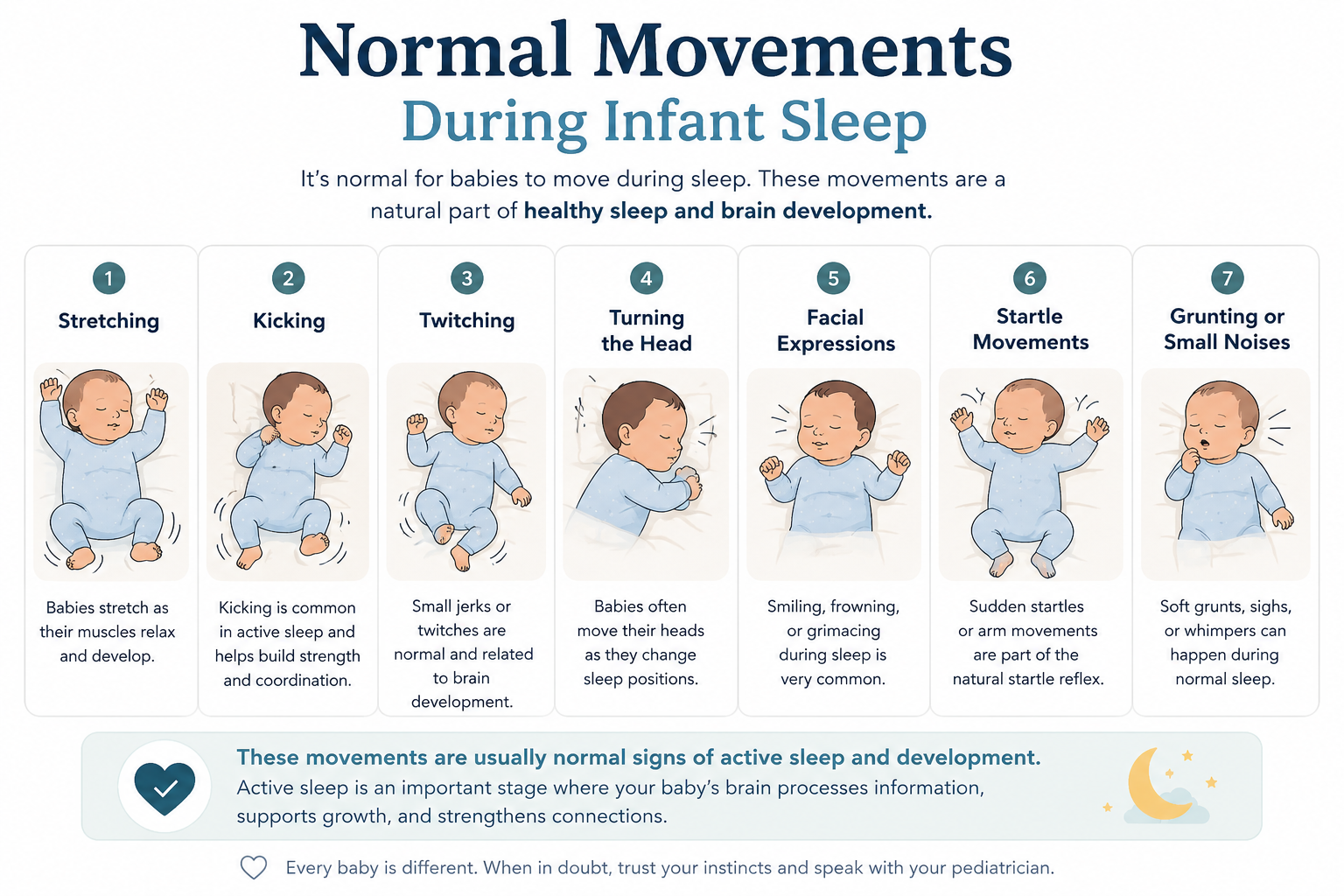
Newborns spend a large proportion of their sleep in what is usually called active sleep, a form of sleep associated with REM. During active sleep, babies may twitch or jerk their arms and legs, move their eyes beneath their closed eyelids, make facial expressions, or briefly move their mouths. Their breathing can also be less regular. These movements are a normal part of infant sleep and are more common during lighter, active sleep.
During deeper, quiet sleep, babies generally become much more still.
These active and quiet sleep stages are relatively short in babies. A full sleep cycle, consisting of active sleep and quiet sleep, typically lasts 40–50 minutes. As one cycle ends and the next begins, a baby may move, stir, or briefly become more active before settling back into sleep. Some of the movements parents notice during sleep are therefore simply part of this transition between cycles.
So, if your newborn suddenly stretches, kicks, or makes a little face while apparently asleep, it does not necessarily mean they are waking or that something is wrong.
As babies grow, the movements you see in a newborn can change considerably.
What Normal Infant Sleep Movement Can Look Like
Normal movement during infant sleep can include:
- brief twitches or jerks of the arms or legs
- stretching or flexing the body
- opening or closing their hands
- sucking or mouthing movements
- facial expressions, including smiles or grimaces
- kicking or moving the legs
- turning their head
- changing position
- briefly stirring or partially waking between sleep cycles
Some movements happen repeatedly, particularly around the transition into sleep or during lighter, more active sleep.
Movement Changes as Sleep Develops
A newborn’s movements are very different from those of a six-month-old baby and very different again from those of a one-year-old child.
This is because sleep and physical development are connected.
During the first months, much of the movement you see during sleep consists of spontaneous movements and reflex activity. A newborn’s nervous system is still developing, so many movements are automatic rather than deliberate. You may see your baby’s arms suddenly extend, their hands open, their legs kick, or their body briefly jerk or startle. These automatic responses, generated by the developing nervous system, can appear suddenly and may briefly interrupt your baby’s stillness without necessarily meaning that your baby has fully awakened.
Then purposeful movement begins to emerge.
A baby learns to reach, push up, roll, sit, crawl, pull up and eventually walk. These new abilities do not necessarily switch off when bedtime begins. A more mobile baby may move more deliberately during sleep and may be able to change position independently.
This is one reason movement during sleep needs to be understood alongside movement while awake.
Newborn Movement During Sleep: Twitching, Stretching and Startling
Newborn movement during sleep can look surprisingly dramatic, especially if you are watching your baby closely for the first time. A baby’s arms or legs may suddenly jerk, their whole body may briefly startle, or they may stretch, squirm, open and close their hands, move their mouth, or make a facial expression that looks almost like a smile.
These movements usually are completely normal and are often most noticeable during active sleep, the early form of REM sleep in which babies are more physically active.
Babies spend a large proportion of their sleep in active sleep and do not yet have the more predictable sleep patterns and longer sleep cycles that develop as they mature. As a result, a newborn may appear restless even when they are comfortably asleep. You may see a burst of movement, followed by stillness, and then another brief period of activity without your baby actually waking up.
At the same time, your baby’s movement while awake is changing rapidly. During the first months, babies gradually develop better head and neck control, move their arms and legs with greater purpose, bring their hands toward their mouths, and push up with their arms during supervised tummy time. These early movements are signs of a developing nervous system and growing muscle control.
These are the first steps in a remarkable progression of movement that will gradually change not only what your baby can do while awake, but also how they move during sleep.

Rolling: A Major Movement Milestone for Sleep
Rolling is one of the most important movement milestones in infancy when it comes to sleep. It marks the point at which your baby begins to have much greater control over their body and can start changing their sleep position independently.
Rolling may begin gradually. Before your baby completes a full roll, you may notice them rocking from side to side, lifting their legs, twisting their body, pushing with their feet, or repeatedly turning onto their side. Eventually, they may discover that they can roll from their back onto their tummy. These early attempts are signs that your baby is developing the strength, coordination and body control needed for more independent movement.
How Rolling is Connected to Safe Sleeping Guidelines
Rolling also has an important connection to safe sleep. This period, when your baby starts rolling but does not necessarily still have full control of their movements, is when you need to follow AAP guidelines for baby safe sleeping.
- If you swaddle your baby, the American Academy of Pediatrics recommends stopping as soon as your baby shows signs of trying to roll. A baby who is beginning to roll needs to be able to move their arms freely and use them to help change or adjust their position. Weighted swaddles and weighted sleep products should not be used.
- You should continue to place your baby on their back for every sleep, even after rolling begins. If your baby can roll comfortably in both directions—from tummy to back and back to tummy—and moves onto their side or tummy during sleep, you do not need to repeatedly turn them back onto their back.
- Make sure that the sleep area is a firm, flat sleep surface, completely clear of pillows, blankets, bumpers, stuffed toys and other objects. As your baby begins to roll and change position independently, they can move their face toward or into these objects. Soft or loose items can press against the nose and mouth and block airflow, creating a risk of suffocation.
Rolling is therefore more than a developmental milestone. It is a visible sign that your baby’s ability to move during sleep is changing, and that their sleep environment needs to be ready for that new mobility.
From Rolling to Sitting
After rolling, babies gradually gain greater control over their whole body. Around the middle of the first year, they begin developing the strength and coordination needed to sit, and by around 9 months, most babies can get themselves into a sitting position and sit without support.
As these new motor skills emerge, you may notice two different changes in your baby’s sleep:
- More movement during sleep: Your baby may roll, turn, kick, push with their arms, change position, or later even sit up in the crib. A baby who once stayed more or less where you placed them may suddenly be much more mobile during the night.
- More difficulty settling or staying asleep: Learning a new physical skill can also coincide with difficulty settling at bedtime, more frequent night waking, or difficulty going back to sleep after waking. Parents sometimes describe this as their baby “practicing” a new skill at night, around the development of skills such as sitting, crawling, cruising and walking.
During the day, supervised movement and floor play—including tummy time—give babies opportunities to develop and practice their growing motor skills. The American Academy of Pediatrics recommends tummy time while babies are awake and supervised.
Crawling, Pulling Up and the Very Mobile Sleeper
As babies become increasingly mobile, their relationship with their sleep space changes again.
Some babies crawl or scoot. Others move in different ways. Eventually, they begin pulling themselves up to standing and cruising along furniture. By 12 months, pulling to stand is a common developmental milestone, and by 18 months, most children can walk without holding on to another person or object.
A baby who has learned to control their body during the day may also shift, reposition and move more during sleep.
And once a baby is pulling to stand, parents need to think beyond the mattress itself. The entire sleep environment—and increasingly the room around it—needs to remain safe for a child who can move, stand up and eventually climb out of the crib.
Does Movement During Sleep Mean My Baby Is Awake?
One of the easiest mistakes for a tired parent to make is to assume that every movement means the baby is awake and needs attention. In reality, babies can be surprisingly active while remaining asleep. A baby may twitch, kick, turn their head, squirm, make a brief sound, or even open their eyes for a moment without fully waking.
Babies also naturally move between different stages and cycles of sleep. During these transitions, you may notice a short period of stirring, movement or vocalization before your baby settles back into sleep.
If your baby appears comfortable and is sleeping safely, a little movement does not necessarily require intervention. You do not always need to pick your baby up, reposition them or try to settle them immediately. In fact, intervening might have the contrary effect, and wake the baby up.
Sometimes, especially during the night, the best response is simply to pause and observe. Give your baby a moment to see whether they settle back to sleep on their own.
When Movement During Sleep Should Prompt a Call to Your Pediatrician
While the vast majority of sleep movement is a normal, healthy sign of a developing nervous system, there are patterns that are worth mentioning to your baby’s doctor.
These include:
- Rhythmic and repetitive movements —such as the same jerking motion in the same limb, repeated at regular intervals for a minute or longer—rather than the varied, brief twitches typical of active sleep.
- Movements accompanied by changes in skin color (paleness, blueness, or a mottled appearance).
- Breathing that stops for more than a few seconds.
- Unusual stiffening of the whole body.
- Eyes that roll back and stay fixed in one position.
- Difficulty to rouse baby, a baby who is unusually limp and unresponsive when awake.
- Μovements consistently triggered by light, sound, or handling in a way that looks more like a startle response than typical sleep activity.
It can be genuinely hard for a tired parent to tell the difference between harmless muscle jerks and something like infantile spasms or another seizure-related event. That is completely understandable, as these can look similar to an untrained eye.
You do not need to make that determination yourself.
If something about your baby’s movement pattern feels different, worrying, or simply doesn’t match what you’d expect from ordinary sleep twitches, it is always reasonable to describe what you saw to your pediatrician, or to record a short video on your phone the next time it happens so they can see it directly.
Trusting your instinct is not overreacting; it is exactly the kind of observation pediatricians rely on parents to make.
Movement and Safe Sleep Go Together
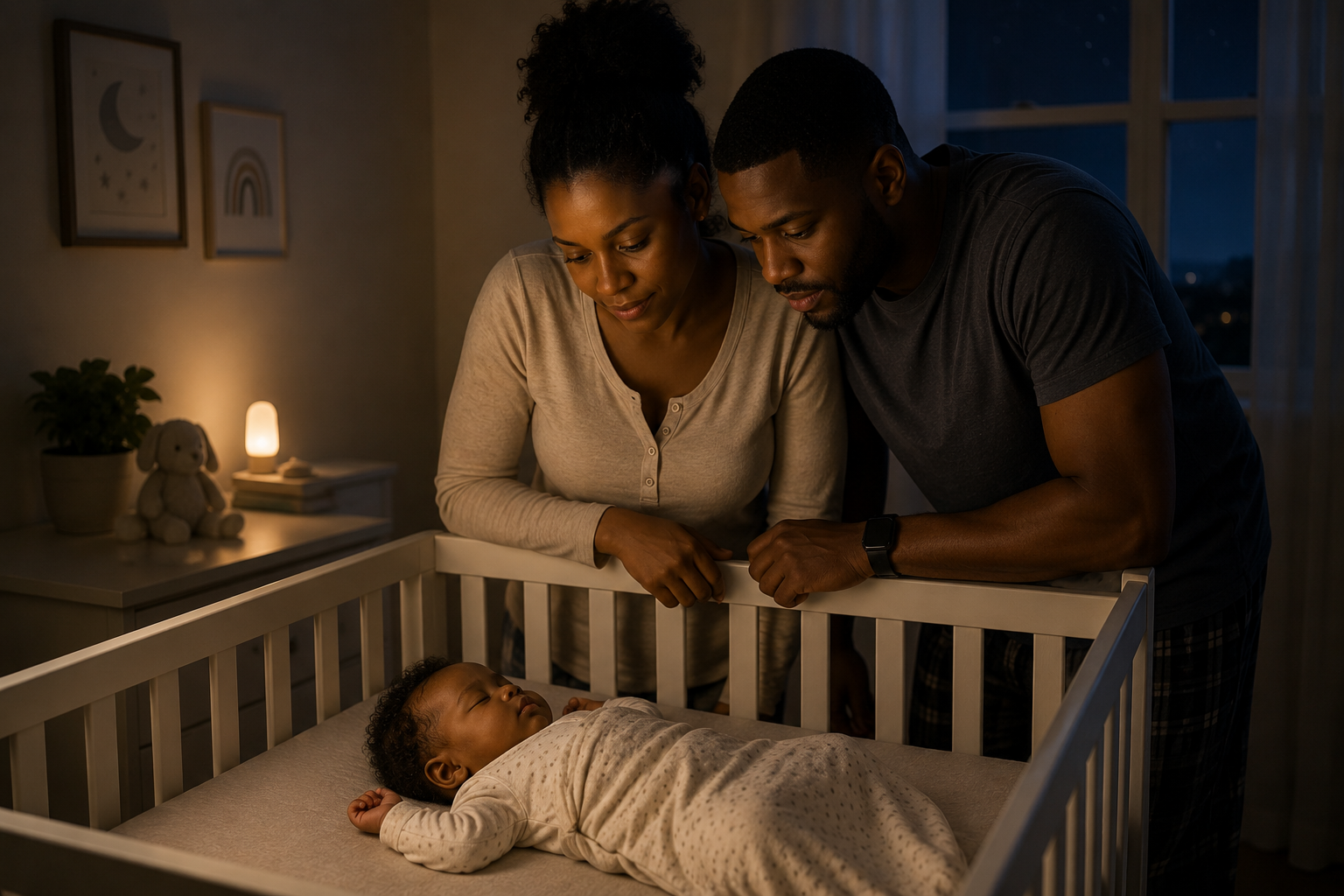
As your baby’s ability to move changes, their sleep environment needs to remain safe.
For infants, the basic principles remain the same:
- Always place your baby on their back for sleep.
- Use a firm, flat, non-inclined sleep surface.
- Keep the sleep space clear of loose bedding and other objects.
- Stop swaddling when your baby shows signs of trying to roll.
- Give your baby plenty of opportunities for supervised movement while awake, including tummy time.
- As mobility increases, reassess the wider environment so that your increasingly active baby can move safely.
Keeping the baby’s sleep space safe is not about preventing your baby from moving. The goal is to give them a safe place in which they can move and grow naturally.