

Rolling: A Major Movement Milestone for Baby Sleep
August 6, 2026
How Multi-Sensor Sleep Monitoring Works
August 12, 2026
Key Takeaways
- Medical monitoring is about health, providing specific physiological information for medical assessment and care.
- Home sleep monitoring is about awareness, helping parents stay informed about sleep-related activity and the sleeping environment.
- A home sleep monitor can give parents greater freedom to sleep, rest and move away from the baby without continuous direct observation.
- Home monitoring does not replace medically indicated monitoring, but it is more than a “nice to have” for everyday sleep awareness.
- The data collected over time can provide useful insight into sleep patterns and, when appropriate, be shared with a healthcare professional.
Parents today have access to many kinds of monitoring technology, but not all monitoring systems are designed to do the same job.
Medical monitoring is designed to monitor a baby’s health when there is a medical reason to do so. Sleep monitoring is designed to help parents stay informed about what is happening while their baby sleeps.
Understanding the difference is not about deciding which one is “better.” It is about understanding what each system is designed to do, when it is used, and how it can help.
Medical monitoring: when health needs to be monitored
Medical monitoring exists because there is a medical reason to monitor. It is used when a baby or patient has a known or suspected medical need, or when a healthcare professional wants specific physiological parameters to be monitored.
Depending on the situation, medical monitoring may measure things such as heart rate, respiratory rate, blood oxygen saturation, blood pressure, cardiac activity, and other physiological parameters relevant to the patient’s condition
The equipment and sensors are selected according to the medical question being addressed. Some systems use sensors that make direct contact with the body; others may use different technologies. The priority is obtaining the information needed for medical care; therefore a medical monitoring system may be more noticeable, involve wires or attached sensors, or require bulky equipment.
The information offered by medical monitoring devices is interpreted within a medical context and medical protocols. It helps healthcare professionals assess a patient’s condition, identify changes and make decisions about their care.
Home sleep monitoring: helping parents stay aware
A home sleep monitor has a different purpose. It is designed to provide information about what is happening while a baby sleeps, without requiring the parent to remain beside the baby throughout the night.
Depending on the technology, a home sleep monitoring system may detect body movement, breathing-related patterns, crying or sounds, temperature around the sleeping surface, changes in the sleeping environment, and more. Smart sleep monitoring devices process this information and can alert the caregiver when predefined events or conditions are detected.
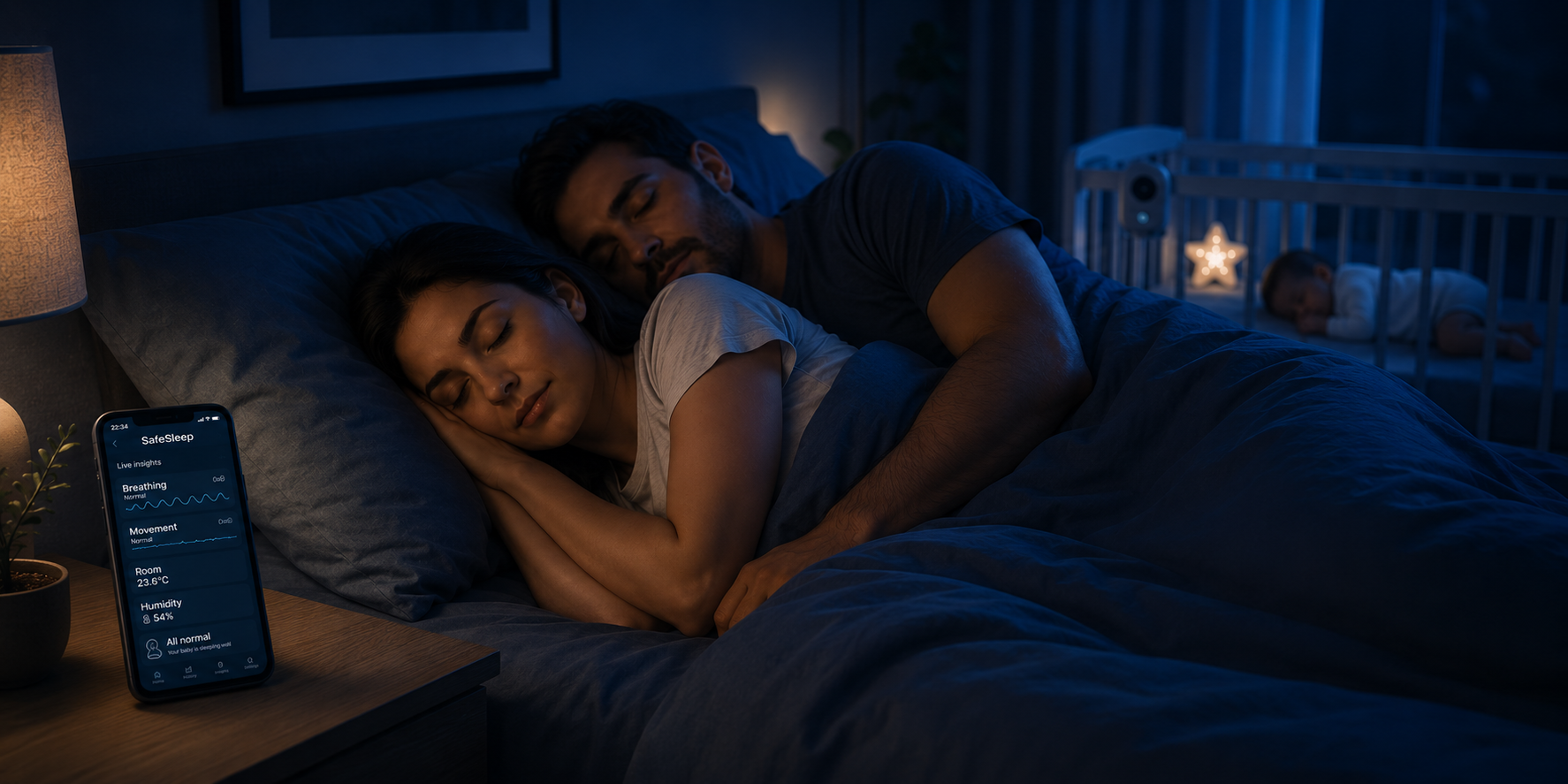
Baby sleep monitors are useful because parents cannot continuously watch a sleeping baby—and they shouldn’t have to. A parent must also sleep and rest, may be in another room, taking a shower, preparing food, working, caring for another child or simply taking a few minutes away from the sleeping area.
Sleep monitoring helps bridge that gap. It offers parents another way to stay informed while they are not physically beside the baby.
Differences between medical monitoring and home sleep monitoring
A medical monitor is designed around a clinical question: What is happening physiologically, and does it require medical assessment or intervention?
A home sleep monitor is designed around an everyday question: What is happening while my baby is sleeping, and is there something I should know about?
Both involve monitoring, but have different purposes and characteristics.
| Medical monitoring | Home sleep monitoring | |
|---|---|---|
| Purpose | Medical assessment and management | Awareness during sleep |
| Used when | There is a medical need or clinical indication | Parents want information about sleep-related activity |
| Measures | Specific physiological parameters relevant to medical care | Sleep-related activity and environmental information |
| Equipment | Designed around clinical requirements | Designed for comfortable, everyday use at home |
| Alerts | Support clinical monitoring and response | Bring predefined events to the caregiver’s attention |
| Information | Interpreted in a clinical context | Helps caregivers understand what is happening during sleep |
Why home sleep monitors are designed differently
The difference in design between medical and home sleep monitoring is important.
For a medical monitor, clinical function comes first. If accurate measurement requires a sensor to contact the body, wires to be attached or equipment to be relatively bulky, those characteristics may be entirely appropriate. Medical monitoring is often used for a defined period, while a patient is being assessed, treated or recovering.
A home sleep monitor has a different function and it may be used every night, for months or years. For that reason, comfort, discretion and ease of use become important parts of the design. The technology needs to fit into everyday life rather than making the sleeping environment feel like a clinical setting. Sensors can therefore be integrated into the sleeping environment, with the aim of collecting useful information while remaining as unobtrusive as possible.
Why sleep monitoring can be useful at home
For healthy babies that do not require medical monitoring, a home sleep monitoring device may offer value in that it allows a parent to step away without having to stop being informed.
That matters during everyday life. Parents need to eat, shower, rest and sleep. They may need to prepare a meal, work from home or spend time with another child. They may simply want to sit in another room while their baby sleeps.
A monitoring system can provide information during those periods.
Instead of requiring constant visual observation, it can watch for the types of sleep-related activity it is designed to detect and bring certain events to the caregiver’s attention.
That does not mean the parent should react to every movement or sound. Babies move, make noises and change their breathing patterns during normal sleep. The benefit from a baby sleep monitor is additional awareness, not constant intervention.
Alerts that tell you parental attention is required
Probably the most important feature of home monitoring is that an alert brings an event to the caregiver’s attention.
The caregiver can then check on the baby and decide what to do next. Not all alerts require action. A movement alert, for example, does not necessarily mean that something is wrong. A change in a breathing-related pattern can have many possible explanations. Crying can have many causes.
This is also why parents should pay attention to their baby even when the monitor has not generated an alert. If a baby looks unwell, has concerning breathing, changes colour, has difficulty feeding or shows other worrying symptoms, parents should respond to what they observe and seek appropriate medical advice rather than waiting for a monitoring system to confirm the concern.
Sleep data can also provide a bigger picture
A home sleep monitor doesn’t only produce alerts. Depending on the system, it can collect information over time about sleep-related activity and the sleeping environment.
This can help parents understand patterns rather than focusing only on individual events. For example, parents may notice changes in movement, sleep patterns, temperature or other measurements collected by the system.
Sleep-related information collected at home may also be useful to discuss with a healthcare professional. A doctor who is evaluating a baby’s sleep or a particular concern may find a record of what has been happening at home useful as part of the overall picture. Home monitoring does not turn the data into a diagnosis, but the data itself does not become meaningless simply because it was collected outside a hospital.
The value is in providing additional information that can be considered alongside the baby’s history, symptoms, examination and other clinical information.
Sleep monitoring and safe sleep work together
A monitoring device is one part of a baby’s sleep environment. It does not replace established safe-sleep recommendations, that need to be followed even if you are using a sleep monitor.
The goal is not to choose between safe sleep and monitoring. It is to combine a safe sleeping environment, appropriate sleep monitoring and parental awareness, while using medical monitoring when a healthcare professional determines that it is needed.
Sleep monitoring can give parents another layer of awareness. It cannot make an unsafe sleeping environment safe, and it cannot replace medical care.

When is each type of monitoring appropriate?
The simplest distinction is this:
Medical monitoring is appropriate when there is a medical reason to monitor. If a healthcare professional determines that a baby needs physiological monitoring, parents should use the equipment and follow the instructions provided by their healthcare team.
Home sleep monitoring is appropriate when parents want additional awareness of their baby’s sleep-related activity and environment. It can be especially valuable during the many hours when parents are not directly observing their baby.
These are not competing technologies.
A baby who needs medical monitoring may need medical monitoring regardless of whether a home sleep monitor is also being used. And a healthy baby who does not require medical monitoring can still benefit from a home system that helps parents stay informed while they sleep and go about their lives.