

Sleep Monitoring vs. Medical Monitoring: What’s the Difference?
August 11, 2026
Baby Room Temperature: Is Your Nursery Too Hot or Too Cold?
September 8, 2026
Key Takeaways
- A multi-sensor approach allows a sleep monitoring device to detect different aspects of a baby’s sleep, including movement, breathing-related signals, sound and sleep-environment temperature.
- Sensor fusion combines information from multiple sensors to provide more context and help the system interpret patterns rather than relying on a single measurement.
- Non-contact sleep monitoring works without attaching sensors to the baby, allowing the device to monitor the sleeping environment without becoming part of the baby’s sleep routine.
- Smart alerts use sensor data and predefined conditions to identify patterns that may require attention, rather than alerting caregivers every time a baby moves or makes a sound.
- A sleep monitoring device provides an additional layer of awareness but does not replace safe-sleep practices, supervision or medical care.
Sleep may look quiet from the outside, but for a baby, the night is full of small changes. A baby breathes, moves, changes position, makes sounds, cries, settles again and responds to changes in the sleeping environment. For a sleep-monitoring system, the challenge is to detect these different signals continuously and understand what they may mean.
This is particularly important when monitoring a baby’s sleep because there is no single signal that tells the whole story. Breathing, movement and sound are different physical phenomena, and each requires a different way of sensing. A baby may be completely still while breathing, suddenly change position, or make a sound without significantly moving at all.
The purpose of a multi-sensor sleep-monitoring system is therefore not simply to detect activity. It is to collect different types of information, combine them and use the resulting picture to determine when an alert may be appropriate.
The Challenges of Monitoring Baby Sleep
Three types of information are particularly useful when monitoring a baby’s sleep: breathing-related movement, physical movement and sound.
Movement is relatively straightforward to detect. A baby turning over, shifting position, moving an arm or leg, or getting up from the sleeping surface produces mechanical changes that sensors can detect.
Sound provides another important source of information. Crying, vocalisations and other sounds can indicate that something has changed, even when there is little physical movement. Conversely, a baby can move considerably without making a sound.
Breathing is one of the more challenging signals to monitor. It produces very small, repetitive movements that can be detected mechanically, while breathing sounds may provide additional acoustic information. Normal breathing can be very quiet, however, so acoustic detection alone is not sufficient.
Why Multiple Sensors Make Sense
Different sensors are good at detecting different things. A pressure plate can tell us that the sleeping surface has changed, while a microphone can detect an acoustic event. A temperature sensor provides information about the sleeping environment rather than the baby’s movement.
Effective sleep monitoring cannot rely on one measurement alone. Most events can be understood more reliably when several signals are considered together.
A night awakening is a good example. It has a movement component, because the baby stirs and moves, and it may also have an acoustic component, because the baby might cry or vocalize if they are startled. However, babies may move or make little voices during the night, without waking up. Looking at movement and sound signals together can provide more information than relying on either one in isolation.
The Sensor Fusion Approach
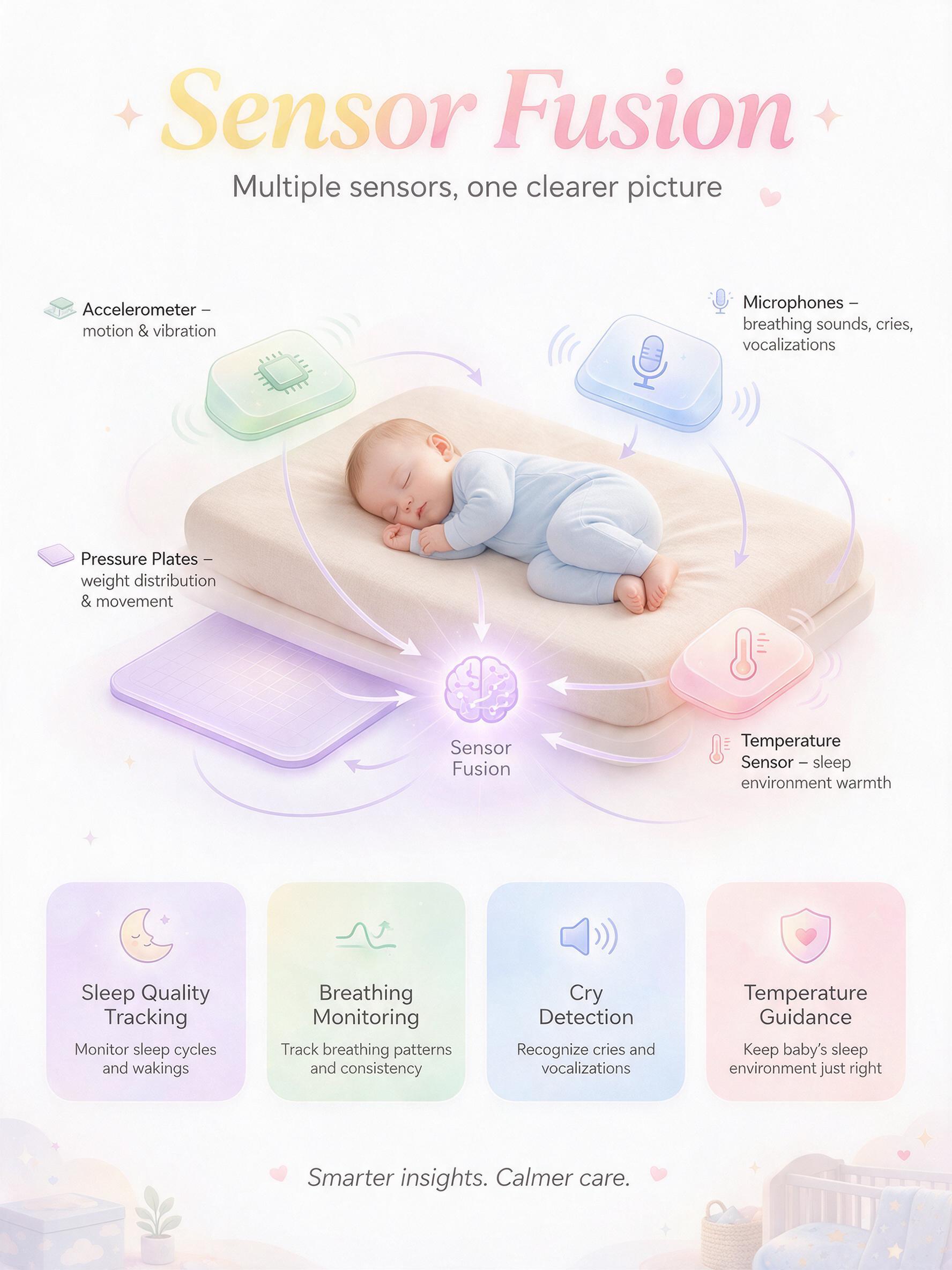
This multi-sensor approach is known as sensor fusion. Instead of asking one sensor to interpret everything that happens, the system combines information from multiple sensors and looks for relationships between them.
The result is not simply more data. It is more context.
A movement detected by the pressure plate can be considered alongside acceleration. An acoustic event can be compared with physical movement. Temperature can provide information about the surrounding sleep environment. By combining these different observations, the system has a broader basis for interpreting what is happening.
Contact and Non-Contact Sleep Sensors
Sleep-monitoring technologies can broadly be divided into contact and non-contact systems.
Contact sensors are placed directly on the person, for example through a wearable device, patch or band. Because the sensor is physically attached to the body, it can measure certain signals directly. However, the device has to remain correctly positioned during sleep and introduces another object into the baby’s sleeping routine.
Non-contact sensors take a different approach. Instead of attaching anything to the baby, they are integrated into or positioned within the sleeping environment. The sensors can detect mechanical, acoustic or environmental changes from the sleeping surface without requiring the baby to wear anything.
For SafeSleep, this unobtrusive approach is central to the design. The sensing technology is integrated into a lightweight mattress pad that sits beneath the flat sheet, so there is nothing to attach to the baby and nothing the caregiver needs to remember to put on before sleep.
The baby simply sleeps as usual while the sensors work in the background.
This is an important distinction between monitoring and interaction. The monitoring technology should collect information without becoming part of the baby’s sleep experience.
The Sensors Working Together
SafeSleep combines several different sensing technologies. Each has a specific role, but their greatest value comes from working together.
Pressure Plates Monitor Weight Distribution
The sensing elements within the sleeping surface detect mechanical changes caused by the baby’s body.
When a baby moves, weight is redistributed across the mattress. Rolling over, moving an arm or leg, moving around during sleep or getting up in the crib, can all change the forces acting on different parts of the sleeping surface.
The pressure plates detect these changes and provide information about physical activity and changes in position.
They can also contribute to detecting the very small, repetitive mechanical changes associated with breathing. These signals are considerably subtler than the movement produced by rolling over, which is why they need to be interpreted carefully rather than treated simply as another movement event.
The important point is that the pressure plates do not need to know what the baby is doing on their own. They provide the raw mechanical information that the rest of the system can analyse to indicate if the baby is sleeping, may be awake or may be moving during a sleep transition phase.
The Accelerometer Captures Movement
An accelerometer measures changes in acceleration and is particularly useful for detecting movement and vibration.
In a sleep-monitoring system, it can detect mechanical activity transmitted through the sleeping surface, from larger movements to much smaller vibrations. Because it produces a continuous stream of measurements, the system can examine not only whether movement occurred, but also its intensity, timing and pattern.
The accelerometer therefore complements the pressure plates and provides another perspective on mechanical activity.
Together, these signals can help distinguish different kinds of movement and provide more context than either sensor could provide alone.
The Microphones Monitor Baby Sounds
Not everything that happens during sleep produces a significant mechanical signal. This is where microphones add another dimension: sound.
A baby can make different sounds while sleep. Normal light breathing, congested or heavier breathing, little voices during active sleep or during transition between two sleep phases, crying because something makes them uncomfortable (hunger, a wet nappy, something that scared them), all these situations can be the occasion for acoustic signals.
Microphones detect these acoustic signals in the sleeping environment and contribute to determining if an alert is needed to raise parental attention. Having said that, microphones are not a medical monitoring device. They can monitor acoustic patterns associated with breathing but they do not directly measure every aspect of respiratory health.
Having acoustic information alongside movement information is particularly useful because sound and movement do not always occur together. A baby may make a sound while remaining relatively still, or move without making an audible sound.
The microphones therefore provide an independent source of information that can be compared with the mechanical signals detected by the other sensors.
The Temperature Sensor
The temperature sensor monitors the temperature of the sleeping environment around the baby.
This is not the same as measuring the baby’s body temperature. Since all our sensors are non-contact ones, the SafeSleep monitor does not capture baby temperature per se. At the same time, temperature sensors embedded under the flat sheet do not provide room temperature: instead, they monitor the temperature under and around the baby, offering metrics that can help parents avoid overheating.
Monitoring the sleeping environment temperature can provide additional context and offer indications to help parents make decisions such as how to dress or cover their baby for a comfortable night.
Temperature changes much more slowly than movement, acceleration or sound, so it contributes a different type of information. It can provide context about the conditions around the sleeping surface while the other sensors monitor more immediate changes.
Again, the purpose of having several sensors is not for all of them to measure the same thing. Their value lies in observing different aspects of the sleeping environment.
From Individual Sensors to Sensor Fusion
On their own, the sensors produce measurements. The monitoring system then processes these measurements together.
Imagine, for example, that the pressure sensors detect a change in the sleeping surface. At the same time, the accelerometer records mechanical activity and one of the microphones detects a sound. The temperature sensor indicates a temperature on the high end. Considered separately, these are simply four sensor readings. Considered together, they may indicate that the sleeping environment is relatively warm and that the baby is becoming more restless, providing the caregiver with useful context.
This is the principle behind sensor fusion.
Software analyses the signals from the different sensors, looking at their timing, intensity, repetition and relationship to one another. It can also account for the fact that ordinary sleep involves movement, sounds and changes in the environment.
The objective is not to make every sensor agree. It is to use the different observations to build a more meaningful picture of what is happening.
This is particularly valuable for breathing-related monitoring. The mechanical sensors may detect tiny repetitive movements, while the microphones may provide additional acoustic information. When these signals are considered together, the system has more information with which to interpret the pattern than it would have from a single sensor.

From Sensor Data to Smart Alerts
A multi-sensor system becomes genuinely useful when it can turn all of this information into something a caregiver can understand.
The sensors may collect information continuously throughout the night, but a caregiver does not need to see every movement, vibration or sound, and a baby does not need parental attention every time they move or cry. What matters is whether the system detects a pattern that meets its predefined alert conditions.
This is where smart alerts come in.
Rather than simply reacting to every individual sensor reading, the system can consider information from multiple sensors before triggering an alert. The aim is to distinguish ordinary sleep activity from a situation that may require the caregiver’s attention.
For example, if the monitor detects slight movement without a corresponding significant sound, it does not immediately interpret this as the baby being awake. Instead, it considers the pattern in context, recognizing that small movements are normal during active sleep or when the baby is transitioning between sleep phases.
The result is a monitoring system that remains vigilant throughout the night, without requiring the caregiver to be continuously attentive. When an alert condition is detected, SafeSleep can notify the caregiver through the device itself, with a light and audible signal, as well as through an alert sent to the caregiver’s smartphone.
Smart alerts create an important distinction between continuous monitoring and continuous notification. The sensors can remain active throughout the night without turning every small change in the baby’s sleep into an interruption for the caregiver.
Monitoring That Helps You Rest
Behind a simple sleeping surface, a multi-sensor monitoring system can involve several layers of technology: mechanical sensing, acceleration sensing, acoustic detection, temperature monitoring, signal processing and sensor fusion.
But the experience for the caregiver is intended to be much simpler.
The baby sleeps. The sensors collect information in the background, in an unobtrusive way. The system processes the different signals and looks for patterns that meet its alert criteria. If an alert condition is detected, the caregiver is notified.
The purpose is not to make a caregiver watch a screen all night. On the contrary, it is to provide another layer of awareness, so that they can rest while knowing that the system is monitoring the sleeping environment and can alert them when its predefined conditions indicate that attention may be needed.
What a sleep monitor cannot do for you
At the same time, it is important to understand what sleep monitoring cannot do.
A SafeSleep monitor does not prevent a baby from moving or rolling, and cannot prevent a problem from occurring. It is not a substitute for safe-sleep practices, supervision or medical care, and it does not diagnose medical conditions.
A sophisticated monitoring system can detect signals, interpret patterns and provide alerts. It cannot control what happens to the baby.
That distinction is at the heart of responsible sleep monitoring. The technology is there to help caregivers stay informed and, when appropriate, get their attention. Its role is not to replace the caregiver, but to give them information while they rest.