

What Can Sleep Monitoring Tell Parents About Their Baby’s Sleep?
July 6, 2026
Baby Sleep Cycles and Sleep Stages: What to Expect from Newborn to Toddler
July 12, 2026
If you’ve ever found yourself barely keeping your eyes open at three o’clock in the morning while your newborn seems surprisingly alert, you’ve probably wondered why babies don’t follow the same rhythm as everyone else. During the day, we work, socialize, eat, and stay active. As evening approaches, we gradually become sleepy, settle into bed, and expect nighttime to be a period of uninterrupted rest.
This daily pattern is driven by one of the body’s most remarkable biological systems: the circadian rhythm. Often called our internal biological clock, it synchronizes our body with the 24-hour cycle of light and darkness. It tells us when to feel alert, when to become sleepy, when to release important hormones, and even when to digest food most efficiently.
Newborns, however, haven’t developed this biological clock yet. Their sleep isn’t organized around day and night, but around feeding, growth, and neurological development. While this can be exhausting for parents, it’s also completely normal. Understanding how the circadian rhythm develops can help you set realistic expectations, support your baby’s sleep naturally, and recognize when sleep patterns are progressing as expected.
What Is the Circadian Rhythm?
The circadian rhythm is usually understood as our internal sleep schedule, but in reality it is much more than that. It is a biological timing system found in almost every living organism, from plants and insects to birds, mammals, and humans. Over millions of years of evolution, living organisms adapted to the Earth’s predictable cycle of daylight and darkness. Rather than simply reacting to sunrise and sunset, they evolved internal clocks that anticipate these daily changes.
In humans, the circadian rhythm coordinates hundreds of biological processes over approximately 24 hours. It influences when we naturally feel awake or sleepy, regulates fluctuations in body temperature, controls the release of hormones, affects digestion and metabolism, and even helps coordinate immune function.
Perhaps most impressively, the circadian rhythm prepares the body before events happen. Cortisol, often called the wakefulness hormone, begins rising before we wake up, helping us become alert. As evening approaches, melatonin production gradually increases, preparing the brain and body for sleep. Even the familiar afternoon dip in energy that many people experience—often between one and three o’clock—is thought to be part of the normal circadian rhythm rather than simply the result of eating lunch.
The circadian rhythm works alongside another system known as sleep pressure. Sleep pressure builds gradually the longer we stay awake, making us increasingly sleepy throughout the day. Together, these two biological systems determine when we feel ready to sleep and when we naturally feel alert.
Why Is the Circadian Rhythm So Important?
Because the circadian rhythm influences far more than sleep, disrupting it can affect many aspects of health.
Researchers have found that adults whose circadian rhythm is repeatedly disrupted—such as shift workers, people with chronic jet lag, or those who regularly sleep at inconsistent times—often experience poorer sleep quality, reduced concentration, impaired memory, mood disturbances, and an increased long-term risk of metabolic disorders, cardiovascular disease, and type 2 diabetes. While many factors contribute to these conditions, maintaining a stable circadian rhythm is considered an important part of overall health.
Fortunately, this doesn’t mean that a few sleepless nights are harmful. The human body is remarkably resilient. These health effects are associated with persistent disruption over months or years, not with the temporary sleep deprivation that every parent experiences after bringing home a newborn.
Newborns are fundamentally different. They are not experiencing a circadian rhythm disruption: they don’t have a circadian rhythm yet and it will take some time for that biological clock to build and mature.
Why Aren’t Babies Born With a Circadian Rhythm?
Indeed, at birth, the brain structures responsible for generating a stable circadian rhythm are still immature. The foundations of the biological clock are already present, but they need time to develop and connect with other systems in the brain before they can reliably organize sleep around a 24-hour cycle.
Instead, newborn sleep is driven primarily by immediate biological needs, especially feeding. During the first weeks of life, babies need frequent nutrition to support rapid growth and brain development. As a result, they naturally wake every two to four hours, regardless of whether it is midday or the middle of the night.
From an evolutionary perspective, this makes perfect sense. A newborn that slept uninterrupted for long periods without feeding would have been less likely to survive. Frequent waking is therefore not a flaw in newborn sleep but one of its most important protective features.
The Brain’s Master Clock
The body’s circadian rhythm is coordinated by a tiny region of the brain called the suprachiasmatic nucleus (SCN), located in the hypothalamus.
Although it contains only about 20,000 nerve cells, the SCN functions as the body’s master clock. It receives information from the eyes about environmental light and uses those signals to synchronize clocks found throughout the brain and the rest of the body.
As infants grow, communication between the eyes, the SCN, and hormone-producing glands becomes increasingly organized. Gradually, the brain begins recognizing daylight as the period for activity and darkness as the period for sleep.
This process cannot be accelerated. Like learning to crawl or walk, the development of the circadian rhythm reflects normal neurological maturation.
Melatonin and Cortisol: The Hormones Behind the Clock
Two hormones play central roles in the development of healthy sleep patterns.
Melatonin helps prepare the body for sleep. In adults, melatonin levels begin rising in the evening as light decreases and remain elevated throughout the night before falling again in the morning. Newborns produce very little of their own melatonin immediately after birth, and this daily rhythm develops gradually over the first few months of life.
Cortisol has the opposite pattern. It naturally rises before waking, helping increase alertness and preparing the body for daytime activity. As babies mature, cortisol also begins following a more organized daily rhythm.
Together, these hormonal changes gradually shift sleep toward the nighttime while promoting longer periods of daytime alertness.
How Light Helps Build the Biological Clock
Although brain maturation follows its own timetable, the environment provides important signals that help guide circadian development.
Light is the strongest external cue for the biological clock. Every morning, daylight reaching the eyes sends signals to the brain that it is time to become alert. As evening arrives and light levels decrease, the brain begins preparing the body for sleep.
Parents can support this natural process by exposing babies to normal daylight during the day. This doesn’t require direct sunlight or special routines. Simply spending time in naturally lit rooms, opening curtains in the morning, or taking a daytime walk outdoors provides valuable information to the developing brain.
At night, the opposite approach is helpful. Keeping lights dim during feeds and diaper changes, speaking softly, and avoiding unnecessary stimulation reinforce the difference between daytime and nighttime without interfering with essential overnight care.
These simple habits won’t instantly create a circadian rhythm, but they provide consistent environmental cues as the brain’s internal clock matures.
When Does a Circadian Rhythm Develop?
Circadian rhythm development is gradual rather than sudden.
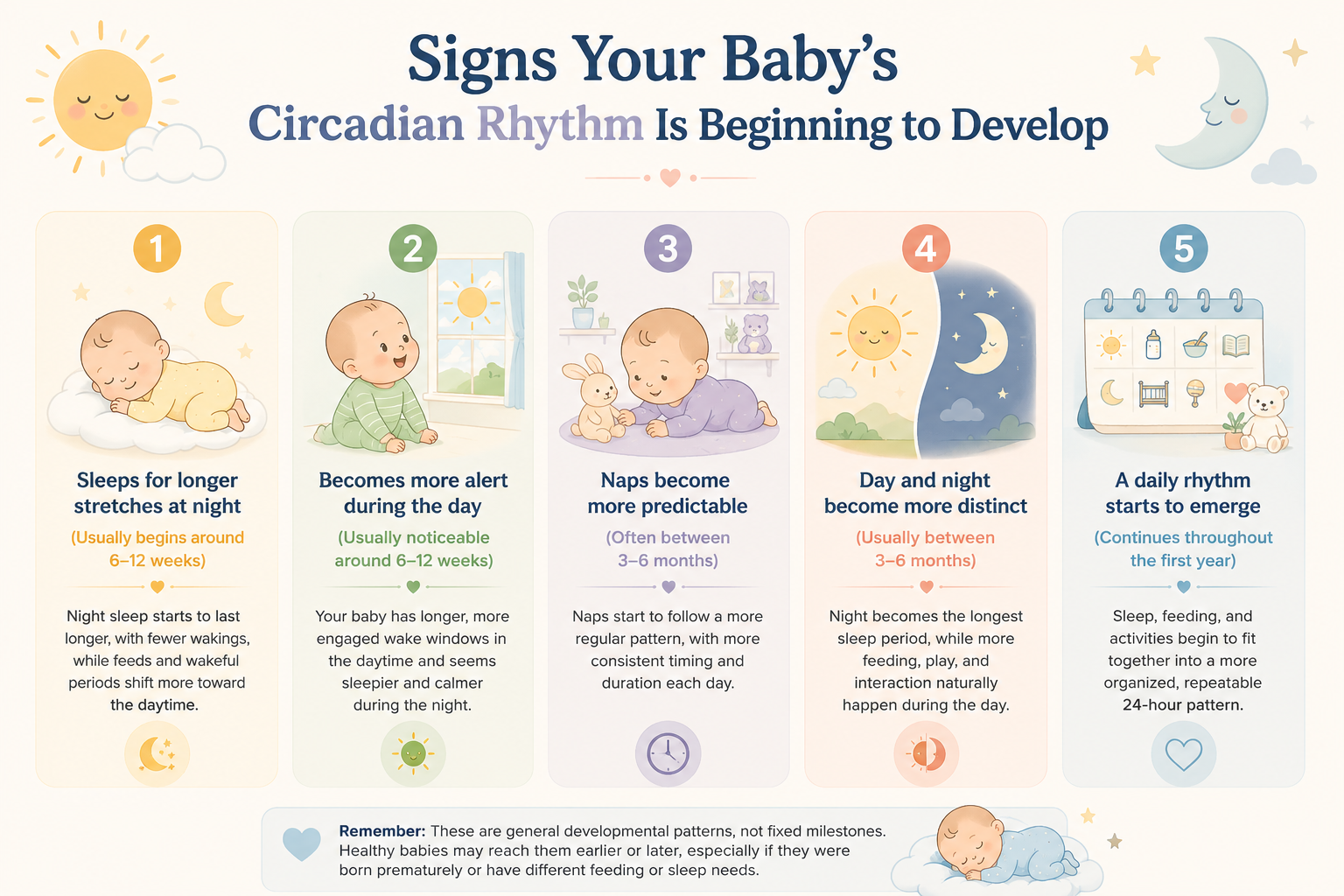
Most healthy infants begin showing the first signs of an emerging day-night rhythm between six and twelve weeks of age, although the process continues throughout the first year. Some babies develop these patterns earlier, while others take longer.
Parents usually notice the changes through everyday observations rather than dramatic milestones. As the circadian rhythm matures, babies often begin sleeping for longer stretches at night, becoming more alert during the day, developing more predictable naps, and spending less time awake overnight.
Prematurity, medical conditions, neurological development, feeding patterns, and individual differences all influence the pace at which these changes occur. Like many aspects of infant development, there is a wide range of normal.
Can Parents Support Circadian Rhythm Development?
Parents cannot force the biological clock to mature more quickly, but they can create an environment that supports healthy development.
Helpful strategies include:
- exposing babies to natural daylight during daytime hours
- keeping nighttime care calm, quiet, and dimly lit
- establishing simple and predictable bedtime routines as babies grow
- encouraging age-appropriate daytime interaction and activity
- maintaining realistic sleep expectations during the newborn period
The goal is not to make a newborn sleep through the night. It is to support the gradual maturation of one of the body’s most important biological systems.

When Should Parents Seek Advice?
During the newborn period, irregular sleep is expected. Waking frequently, sleeping at unusual hours, and having no clear distinction between day and night are all normal features of early infancy.
As babies grow, however, parents should gradually begin to notice an emerging daily rhythm. If, after several months, an infant continues to show no signs of day-night organization, or if sleep concerns are accompanied by poor growth, developmental delays, breathing difficulties during sleep, or excessive sleepiness, it is worth discussing these observations with a pediatrician.
In the vast majority of healthy infants, however, the circadian rhythm develops naturally with time.
The Takeaway
While adults depend on a fully developed circadian rhythm to function at their best, newborns begin life without one. Their irregular sleep isn’t a problem to solve—it is a normal stage of neurological development.
As your baby’s brain matures, it gradually builds the internal biological clock that will regulate sleep, hormones, metabolism, body temperature, and many other essential functions for the rest of life.
Rather than worrying about getting your newborn onto an adult schedule, focus on providing consistent light during the day, a calm and dim environment at night, and the patience that every developing brain deserves. In time, your baby’s internal clock will emerge naturally, bringing with it one of the most important milestones in healthy sleep development.